What is a tick?
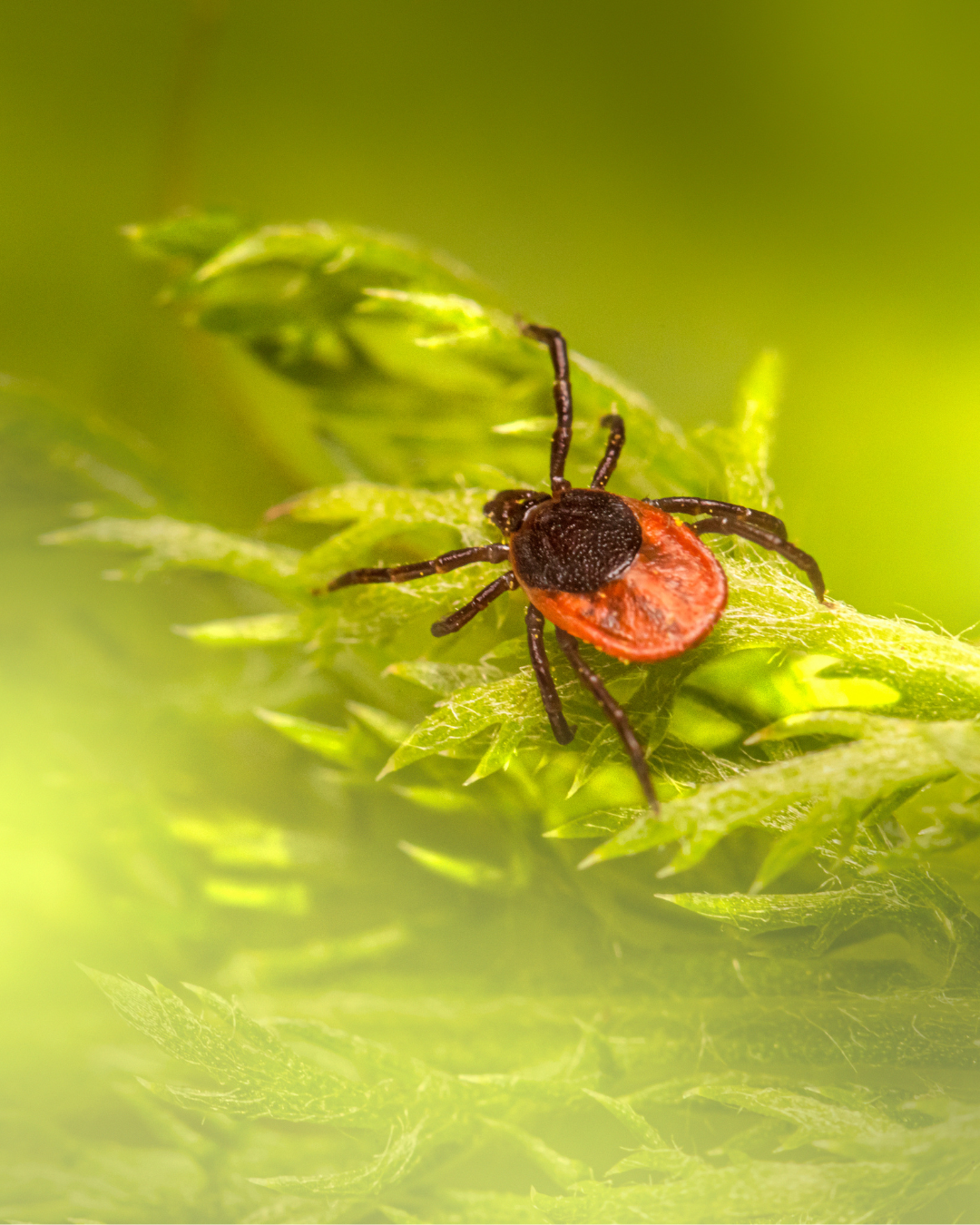
Ixodes ricinus is a blood-feeding mite arthropod, an ectoparasite of vertebrates. An arthro-hema-what? In other words, it feeds on the blood of vertebrates by attaching itself to the skin of its host, which are small or large mammals and sometimes birds. Yes indeed! It is a cousin of spiders, although it is often mistakenly thought to be an insect. 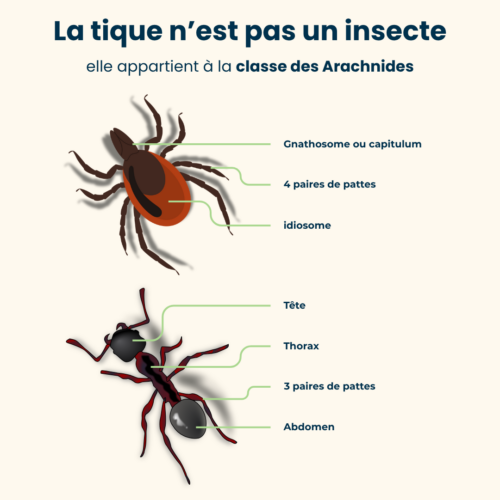
Its life cycle is quite distinctive because it is, in fact, a trilogy after hatching from the egg, with each stage potentially stretching over more than one year, for a complete cycle that can reach… six years! This type of cycle is therefore described as triphasic: the larva, the nymph and the adult. But what really makes it famous (or feared) is its role as a vector of pathogens.
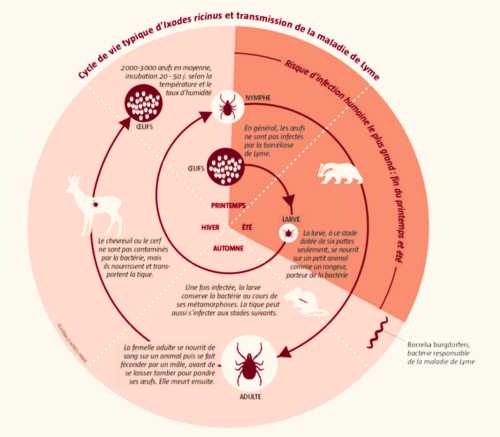
Its habitat depends on multiple scales: from microhabitat to the entire landscape, including abiotic factors (temperature, humidity, light) and a varied range of hosts. The announcement of its dream habitat: a cool forest understorey, forest edges, hedgerows, thickets and tall grasses, all bathed in generous humidity and protected by shade. For Ixodes ricinus, finding a habitat is a survival mission: avoiding dehydration at all costs.
The highly effective modus operandi of Ixodes ricinus
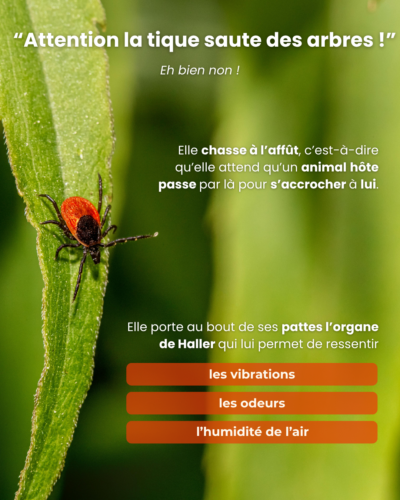
Perched on vegetation, sometimes up to one metre high, it extends its front legs, equipped with sensory organs: Haller’s organ. It is a true radar, able to detect carbon dioxide and the odours given off by warm-blooded hosts. As soon as an interesting host passes within reach, it’s action time! The tick latches on in a flash to fur, clothing or skin with its mouthparts.
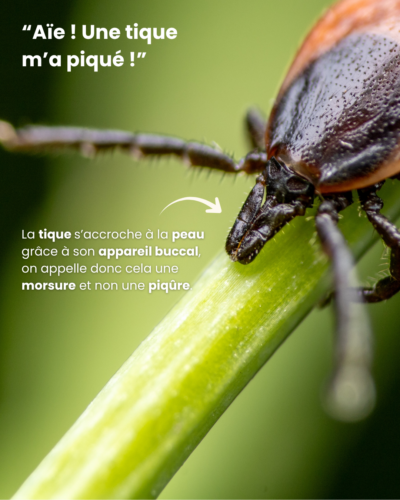
Its chelicerae, true blades, cut the skin painlessly thanks to the simultaneous injection of its saliva containing anaesthetic substances. Then it’s time for the feast! The tick begins its blood meal. It continuously injects a magic cocktail: saliva containing anticoagulants, immunosuppressants as well as anaesthetics. But beware! It is during this feeding phase that potential pathogens, such as the Borrelia burgdorferi bacterium responsible for Lyme disease, can be transmitted to the host via its saliva. It then ingests the blood, its body gradually swelling until it multiplies its weight by one hundred or two hundred times in a few days! The duration of the meal varies depending on its stage of development: three to five days for the larva, four to seven days for the nymph, and up to two weeks for the adult female. Finally, once full, the tick detaches spontaneously.
A greedy and contagious traveller…
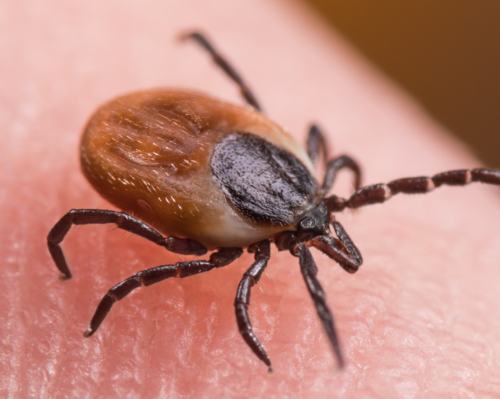
At each stage of its life (larva, nymph, adult), our tick changes its menu… This meal is not always without consequences. If one of its hosts carries a bacterium, a virus or a parasite, the tick ingests it with the blood. A tick that is healthy at birth can thus become a vector of diseases after just one meal on an infected host, and then spread the infection to all its future hosts.
This mechanism makes ticks major players in the transmission of diseases that pass from animals to humans: zoonoses. One more reason to adopt a global approach, such as the One Health concept. Because in nature, everything is connected!
An ecologist despite itself?
They may not be among your favourite guests, but ticks do have their place in the ecosystem. An essential link in the food chain, their role does not stop there: by parasitising rodents, deer, wild boar or birds, they act as natural regulators. By mainly targeting young or weakened individuals, they prevent the overpopulation of certain species, thus protecting vegetation from devastating overgrazing. And that’s not all! Their presence even stimulates the evolution of their hosts’ immune defences, strengthening ecosystem resilience. But beware, it’s not all rosy: ticks also have their dark side. Vectors of diseases and a source of physiological stress for their hosts, they pose serious challenges to the individuals they parasitise.
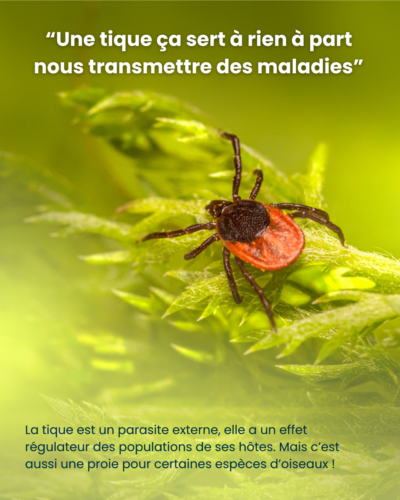
Their sudden disappearance could disrupt biodiversity, but their proliferation, driven by climate change, is becoming increasingly worrying for public and veterinary health. In short, we cannot do without them, but we must learn to live alongside them with caution!
Sources
- Karen D. McCoy, and Nathalie Boulanger. “Ticks and tick-borne diseases: biology, evolutionary ecology, epidemiology.” Institut de Recherche pour le Développement, Marseille (2015).
- Athena Salhi. “From egg to death, live in the skin of a tick”. Salamandre Dossier (2026).
- Valerie Obsomer, et al. “Spatial disaggregation of tick occurrence and ecology at a local scale as a preliminary step for spatial surveillance of tick-borne diseases: general framework and health implications in Belgium.” Parasites & vectors 6.1 (2013): 190.
- Claude Rispe, et al. Ticks and health: Biology, diseases, risk management. INRAE, Quae editions (2026).
- TiquesNet Project, Sciensano (2026).
- Ticks, The Environment in Wallonia (2026).