At this time of year, many people notice and wonder why birds are singing less. Several factors can explain this observation.
The end of the breeding season
For many species, August marks the end of the breeding season, and thus the end of the need to mark their territory, attract females, or even depart on migration to distant wintering grounds.
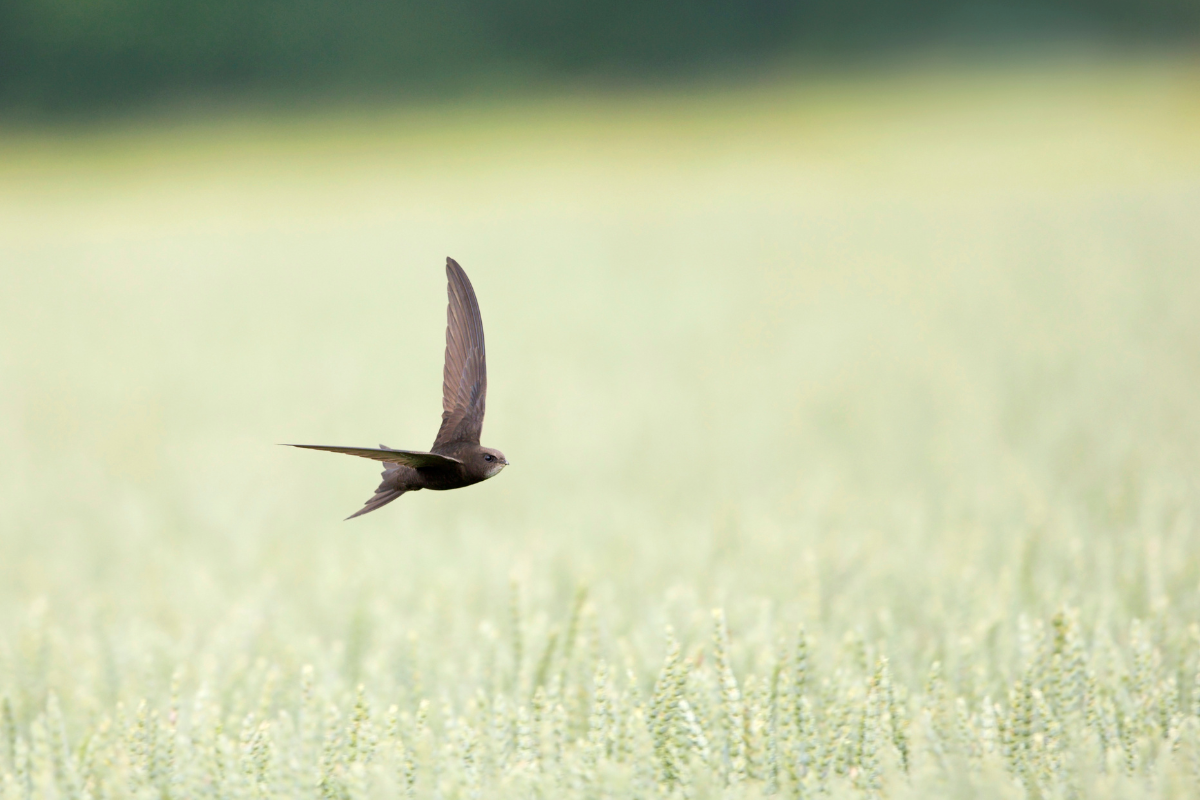
The common swift, which breeds in our cities, is a good example. This species covers very long distances over the course of a year between its wintering quarters, mainly in Southern Africa, and its breeding sites located notably in Europe. Its calls therefore only resonate in our streets from May to early August, corresponding to its departure on migration after the young have fledged.
Besides migratory species, sedentary species—that is, those that do not migrate, such as tits, the blackbird, or the Eurasian wren—significantly reduce their singing as summer progresses. Unlike in early spring, males no longer need to display their territory to potential rivals or search for a female. Furthermore, some species are still busy raising young hatched during summer and therefore devote most of their time to foraging for food.
Impact of Heatwaves
The heatwaves observed this summer also impact the behavior of birds. Adults may prematurely abandon nests, those birds nesting under roofs can end up asphyxiated by the heat, or they may become exhausted by traveling long distances to find water sources. This leads to a decrease in singing behaviors among birds.
The continuous decline of many species over several decades
Birds are one of the most monitored biological groups by scientists and naturalists. This provides a significant amount of data for tracking temporal changes in bird populations.
Overall, birds show significant losses. A study showed that between 1980 and 2009, the abundance of birds had decreased by 20%, estimating a loss of 421 million individuals, in Europe (Inger et al., 2015).
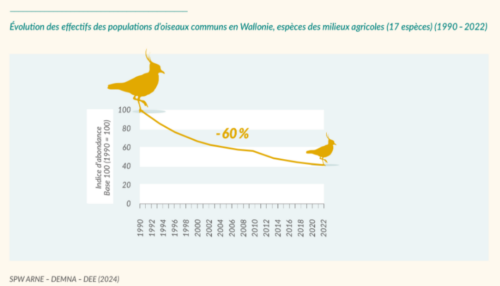
In Wallonia, not all bird groups are affected in the same way. For example, between 1990 and 2020, species in agricultural environments lost approximately 60% of their numbers, while forest species showed a decrease of about 32% (Derouaux, 2021; Diagnostic environnemental de la Wallonie, 2024).
 These declines result in a significantly lower number of singing birds, making our cities and countryside quieter. These changes profoundly alter the acoustic diversity and intensity of the soundscapes of our regions, which could eventually lead to effects on our health and human well-being (Morrison et al., 2021).
The reasons for these changes are numerous:
- intensification of agricultural practices (increased pesticide use, destruction of hedges, etc.);
- degradation of natural habitats;
- changes in wintering areas;
- or climate change.
This phenomenon has been highlighted for a very long time, notably with the publication of ‘Silent Spring’ in 1962 by Rachel Carson, considered one of the founders of the environmental movement.
Despite these declines, several conservation projects have helped safeguard and reverse these negative trends for certain species. For example, at the local level, the actions to preserve house martins in Brussels have led to a remarkable increase in their numbers (Pailhes et al., 2025).
In conclusion
August is marked by a sharp decrease in bird song, making dawn and dusk more silent. This is explained by the natural cycle of species throughout the year. However, successive heatwaves and long-term changes in bird populations are also factors contributing to this increased silence in our regions.
Source
Derouaux, A. (2021): Monitoring of common birds in Wallonia 1990-2020. Report to observers. 64 pp.
Environmental Diagnosis of Wallonia. (2024). https://etat.environnement.wallonie.be/home/diagnostic/biodiversite-1.html
Inger, R., Gregory, R., Duffy, J. P., Stott, I., Voříšek, P., & Gaston, K. J. (2015). Common European birds are declining rapidly while less abundant species’ numbers are rising. Ecology letters, 18(1), 28-36.
Morrison C.A., Auniņš A., Benkő Z. et al. Bird population declines and species turnover are changing the acoustic properties of spring soundscapes. Nat Commun 12, 6217 (2021). https://doi.org/10.1038/s41467-021-26488-1
Pailhes M., Paquet A., Feys S., Paquet J.-Y., and Derouaux A., 2025. Atlas of breeding birds of the Brussels-Capital Region 2022-2024, Natagora, Report of the Studies Department, 2025. Funded by Bruxelles Environnement