The ash is an emblematic tree of our countryside, hedges, and forests. However, for several years, it has been severely affected by a disease called ash dieback. This disease is caused by a fungus that spreads via wind-borne spores.
What is ash dieback?
Ash dieback is caused by a fungus originating from Asia, Hymenoscyphus fraxineus.
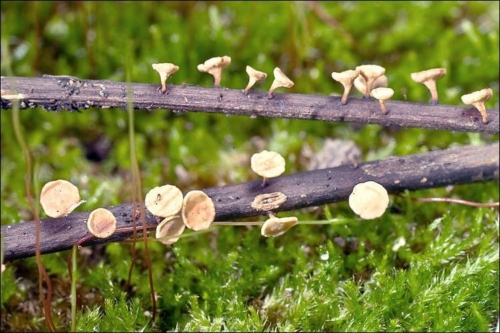
Appearing in Europe in the 1990s, it rapidly spread across the continent. In Belgium, the first cases were observed in the early 2010s. The fungus primarily infects leaves before progressing into the branches and trunk. The most frequent symptoms are:
- wilting of leaves;
- necrosis on twigs;
- progressive dieback of branches;
- epicormic shoots appearing at the base of the tree;
- necrosis at the root collar;
- general weakening that can lead to the death of the specimen.
Young trees are particularly vulnerable, but even mature ash trees can be severely affected.
Why is this disease a concern?
The ash tree plays an important role in many Walloon and Belgian ecosystems.
Its leaves feed numerous insect species. Its cavities provide shelter for birds, bats, and small mammals. Its root system also contributes to stabilizing banks and limiting erosion.
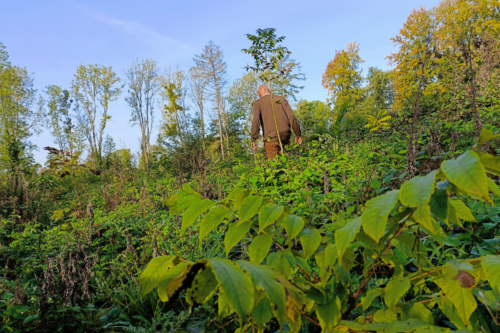
The massive disappearance of ash trees therefore leads to several consequences:
A loss of biodiversity
Many species depend directly or indirectly on the ash tree. Their habitat shrinks as the trees decline.
A weakening of landscapes
Tree alignments, hedges, and forests are gradually changing face. Certain areas are losing plant diversity and ecological resilience.
Safety risks
Diseased trees become more fragile. Branches can fall and trunks can degrade, which sometimes requires safety interventions in public and private spaces.
Can ash trees be saved?
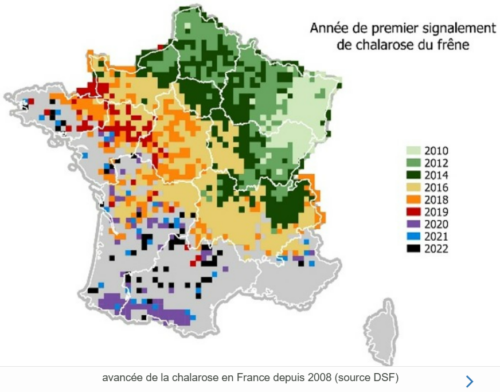
Ash dieback has heavily affected ash trees in Europe for several years. However, recent episodes of heat and drought seem to have helped slow the progression of the disease in certain situations (see map below).
Better still, certain related species, such as Fraxinus ornus, naturally present in East-Mediterranean regions, show better resistance.
Observations conducted throughout Europe show that a small proportion of ash trees exhibit natural resistance to the disease. These individuals now represent hope for conservation and selection programs.
However, no miracle solution currently exists to eradicate ash dieback on a large scale.
The most effective approach consists of:
- monitoring the health status of trees;
- conserving resistant individuals;
- diversifying plantations;
- restoring ecosystems that are more resilient to diseases and climate change.
Diversifying for better resistance
Ash dieback highlights a reality that is often underestimated: diversified ecosystems resist crises better.
When a landscape relies heavily on a single tree species, a disease can quickly cause significant damage. Conversely, mixed hedges, diversified orchards, or plantations composed of several species offer better adaptive capacity.
This is why ecological restoration projects now seek to promote:
- multi-species hedges;
- ecological corridors;
- standard orchards;
- agroforestry plantations;
- diversified reforestation.
This approach benefits biodiversity, carbon storage, and the resilience of territories.
Acting together for more resilient territories!
Find out more:
If you want to learn more about ash dieback, we invite you to visit the INRAe website: