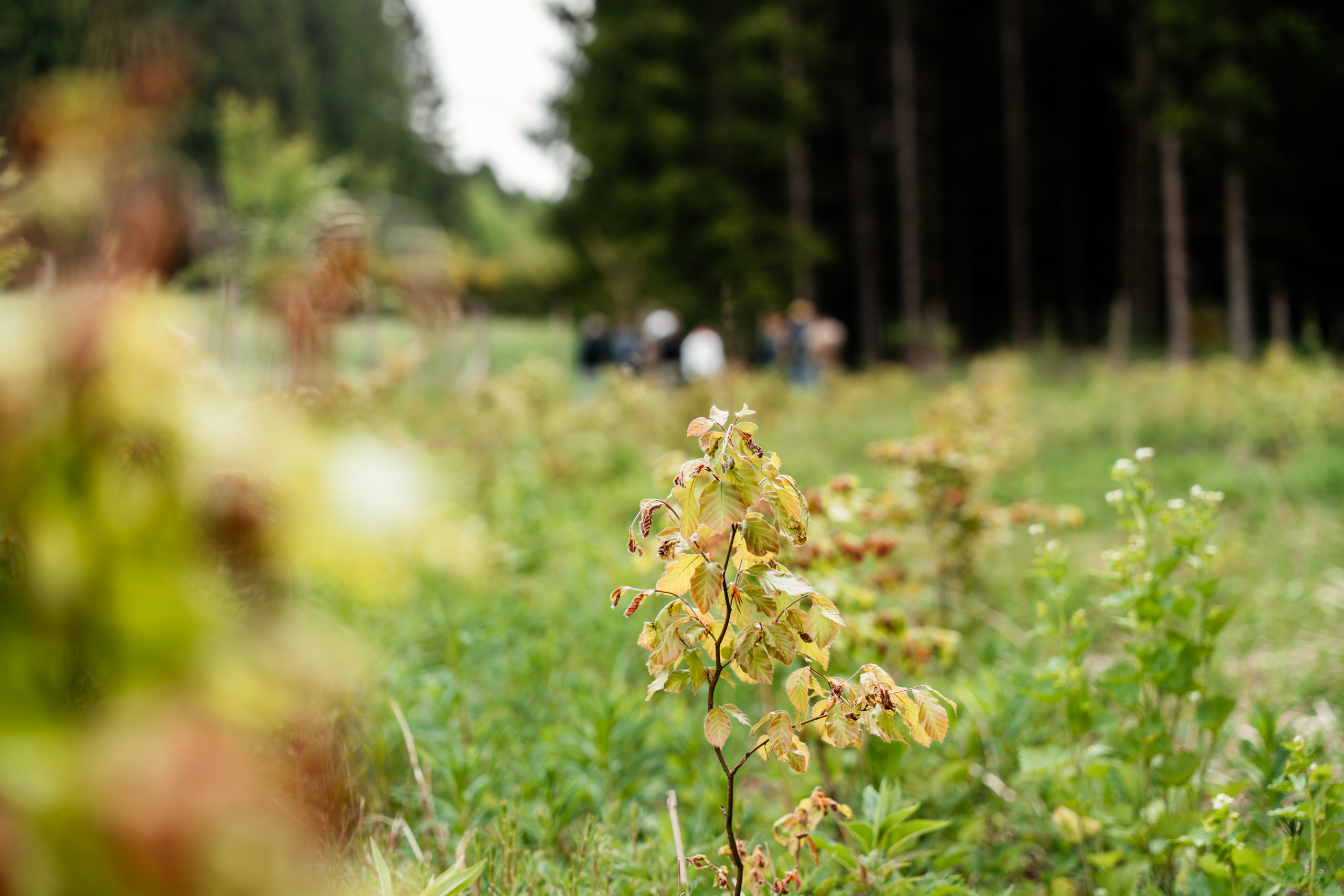
In Cerfontaine, PlantC supported the reforestation of 1,125 trees! In total, there are seven different species.
On the plot, 26% conifers and 74% deciduous trees!
This combination consists of deciduous and coniferous species and is part of a reforestation following a spruce windthrow.
The planting was carried out by Mr. Monseur, an experienced forestry coach. It is a diversified reforestation of pines and deciduous trees, full-area planting and in small cells.
Using a diversity of species is beneficial for birdlife (flowers, fruits and acorns, food sources for birds, insects and small mammals, for example). When leaves fall, humus is generated. Furthermore, these are species with complementary root systems. This will impact the recycling of deep elements, the biological activity of the soil, the fixation and structuring of the soil.
- Planting period: November 2023.
- Project PEFC.
- Survival rate: >80%
- 93.26 tonnes of CO2 sequestered over 30 years.
Project conducted in partnership with the Royal Forestry Society of Belgium.
-
1,125 trees in CerfontaineGet inspired
Plot visit in 2025
April 25, 2025, upon arriving at the plot, we quickly got a view of the new plantings. The forester recalled the context: a very gradual clear-cutting of plantations affected by bark beetles, spread over several years. This was not done all at once.
Two practices were applied. One practice on a first area was that after clear-cutting, the flail mower was used. Then, for 2 years, no action was taken on this plot. Planting was easy to carry out, full-area planting with a spacing of 3 meters between lines, by 2.5m. With a mix of species.
In a second area, to the North, the flail mower was not used. The logging residues were grouped into windrows. Planting was not carried out full-area due to the presence of stumps. Indeed, a complete cell planting of 9 seedlings was carried out. Among these 9 seedlings, 5 will be target plants, and 4 for infill. The same mix of species was used as on the first plot.
Roe deer and wild boars are present in the region. Therefore, protection by fencing was chosen. However, for the second plot to the North, individual tree shelters were chosen. Small tip: the tree shelter also protects against herbaceous plant pressure.

The choice of species
The species were selected based on several tests conducted on the ground, and also by referring to the Ecological Species File. Historically, oak forests are found in this locality. However, they have been suffering for several years (lack of soil depth, repetitive drought; symptoms include defoliation and black streaks on the trunk). Mr. Monseur therefore opted for an enrichment in species to diversify the forest.
We find 3 “target” species (Scots pine, sweet chestnut, wild service tree). Knowing that no sweet chestnut had been planted in the Senzeilles region before. The wild service tree, however, is present in a scattered manner. It is chosen because despite its slow growth, it is a species that can last in the long term, compared to the sweet chestnut. Like oak, its wood is interesting. The wild service tree is no longer sought after today due to the monopoly taken by oak and beech, which has gradually devalued most of our noble species. Nevertheless, the wild service tree, which has interesting qualities, was highly valued in the past and therefore has its place today in an approach to diversify and revalue our indigenous species. The wild apple tree was chosen in favor of biodiversity (flowers, pollen, fruits).


Cell planting
For cell plantings: at the cross-shaped center, the target species, and at the four corners of the square, sycamore maple or hornbeam. Between the cells, we allow for natural regeneration. There are also a few rows of silver birch, even though it is naturally present. Sycamore maple was favored in the hollow.
In terms of management, even if bramble is sometimes contained (only in the rows), the objective is to intervene as little as possible given periods of drought (ground cover can protect the soil from drying out). In some time, foxgloves will bloom in all their splendor! In spontaneous presence, we also find woody species such as oak, hornbeam, beech, ash, wild cherry, sycamore maple, and field maple.
Forest area inherited from Mr. Monseur’s great-grandfather, we know the planting is in good hands!
Immersion
On June 6, 2025, we visited the plot in the company of the forester and Arnaud. This is thanks to the support of companies such as Wallonie Entreprendre, Vo-Group and Smart2circle.


Forest
-
Planting / installation period2023
-
PEFCYes
-
Number of trees1 125
-
Area10 000 m²
-
Carbon93.26 T of carbon sequestered over 30 years
List of selected species
| Scots Pine | 300 |
|---|---|
| Sweet Chestnut | 260 |
| Wild Service Tree | 150 |
| Silver Birch | 225 |
| Hornbeam | 140 |
| Sycamore Maple | 40 |
| Crabapple | 10 |