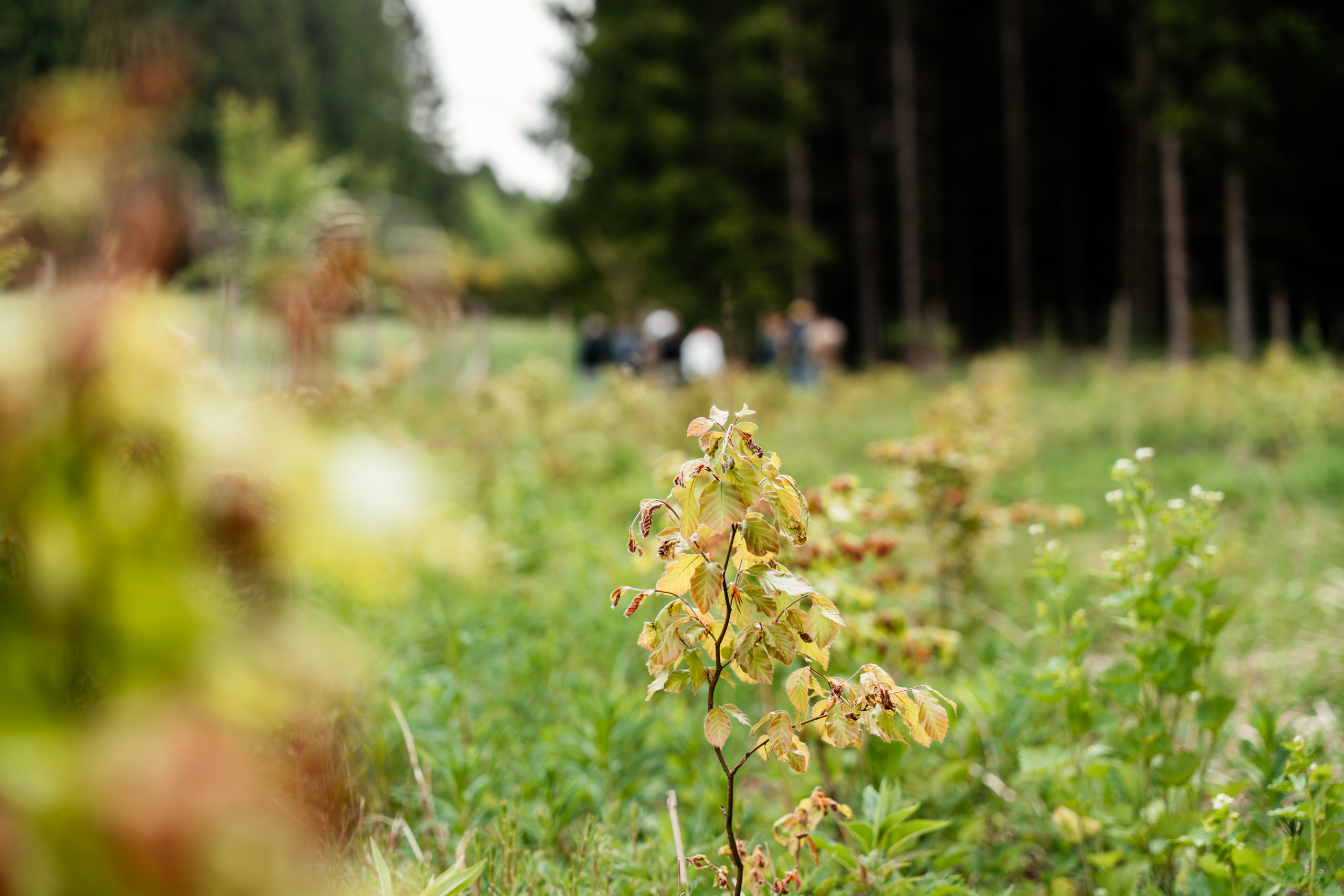
In Meix-devant-Virton, this is a reforestation project where PlantC supports 1,875 trees across 0.6 hectares. Three species are planted: sessile oak, Scots pine, and Corsican black pine.
This combination of deciduous and coniferous species is part of a reforestation effort for a conifer plot affected by bark beetles.

Utilizing a diversity of species is beneficial for avifauna (e.g., flowers, fruits, and acorns, which are food sources for birds, insects, and small mammals). Consequently, when leaves fall, humus is generated, and root systems are complementary. This will also impact the recycling of deep elements, soil biological activity, and soil fixation and structuring.
- Planting period: January 2024.
- Recovery rate: over 95%.
- 104.02 tons of CO2 sequestered over 30 years.
Project carried out in partnership with the Royal Forestry Society of Belgium.
-
A reforestation project in Meix-Devant-VirtonGet inspired
Visit to the Meix-devant-Virton plot in 2025
The owners, seeing the bark beetle increasingly affecting their stand, took the initiative to cut and harvest the existing spruce stand. They then decided to replant through the SRFB x PlantC support program, and therefore first rotary-mulched the plot to allow for replanting, and then replanted.
Unfortunately, African swine fever (a disease affecting wild boar) prohibited all passage and access to their plot to prevent further spread of the disease. It was therefore impossible to provide proper maintenance to the plantation, and it quickly became completely overgrown.


Once the disease was contained, the owners chose to take back control of the plantation by milling strips and replanting with sessile oak and Corsican black pine.
Since then, with careful monitoring by neighbors, the plantation is thriving and showing fabulous growth!
Species Selection
The choice of species primarily favors production, with a dominance of conifers adapted to the Ardennes context. This is a judicious choice, as species like pine and oak are true assets in this climate change context.
A brief overview of the species:


The Scots pine, also known as common pine, is a widespread species in Europe and well-adapted to difficult conditions: it tolerates cold, poor and dry soils, and even grows at high altitudes. It is recognizable by its orange bark on the upper part of the trunk. Its wood is used for construction, pallets, and posts.
The Corsican black pine is a subspecies of black pine native to the Corsican mountains. It is valued for its straight growth habit, longevity, and high-quality, dense, and durable wood. More demanding than the Scots pine, it prefers mild mountain climates and well-drained soils. It is often planted for long-term forestry production.
The sessile oak, also known as durmast oak, is an emblematic forest species in Europe. It is distinguished from the pedunculate oak by its acorns, which are attached directly to the twigs (without a peduncle). It prefers rather dry and well-drained soils, often in hilly or undulating terrain. Robust and durable, its wood is highly sought after for timber framing, barrels, and furniture. It is a valuable species in silviculture, capable of resisting moderate droughts well and playing an important role in mixed forests.

It was a lovely rainy visit in July 2025! See you soon for new forest adventures 🌲
Forest
-
Planting / installation period2024
-
PEFCYes
-
Number of trees1 875
-
Area6 000 m²
-
Carbon103.02 T of carbon sequestered over 30 years
List of selected species
| Corsican Pine | 900 |
|---|---|
| Sessile Oak | 875 |
| Scots Pine | 100 |