The Context
In Nassogne (Lesterny), a former spruce plantation was severely impacted by bark beetle attacks.
These pests caused massive dieback of the firs, leaving behind a weakened plot located on a steep south-facing slope.
Certain areas, difficult to mechanize due to the slope, were left for natural regeneration. Today, we observe the gradual establishment of birches, oaks, and Douglas firs, demonstrating a forest dynamic already underway.
The challenge: transform this health crisis into an opportunity for forest resilience.
Project objectives
- Planting period: March 2025.
- Survival rate: >86%.
- 324.00 tonnes of CO2 sequestered over 30 years.
The site is considered limiting with low productivity, which requires an adapted choice of species and a cautious approach.
The implemented strategy
Rather than a monoculture, the choice was made for a highly mixed broadleaf and coniferous plantation, integrating species with complementary functions:
Coniferous species: 4 coniferous species constitute the reforestation: Cedar, Scots Pine, Corsican Pine, Calabrian Pine, to which must be added Douglas fir (present in natural regeneration)
Broadleaf species with high ecological value: 4 broadleaf species constitute the reforestation: Hornbeam, Linden, Wild Service Tree, Apple Tree, Pear Tree, to which must be added oak and birch (natural regeneration)
This diversity enables:
- Staggered production over time.
- Better resistance to climate stress.
- Varied food sources for wildlife (acorns, fruits, melliferous flowers).
- Enhanced biological activity in soils.
Oak, in particular, plays a central role in stimulating soil life and the ecological structure of the stand.

A biodiversity-focused project
Beyond forest restoration, this project enhances:
- Availability of fruits and acorns for wildlife
- Melliferous resources for pollinators
- Structural diversity (varied layers and ages)
- Soil stability on slopes
The presence of young natural regeneration (Douglas fir, birch, oak) is integrated into the design to create a living and evolving forest system.
A forest designed for tomorrow
The Nassogne reforestation illustrates a contemporary approach to forest management:
diversify, anticipate, stabilize, and allow space for natural dynamics.
In the face of health and climate crises, the response is not identical replacement, but the creation of richer, more mixed, and more resilient forest ecosystems.
-
Former spruce plantation attacked by bark beetles in NassogneGet inspired
March 2025 planting
The planting was carried out in March 2025, then verified in autumn (October 21, 2025):
Survival rate: 86%
Survival is general across all species.
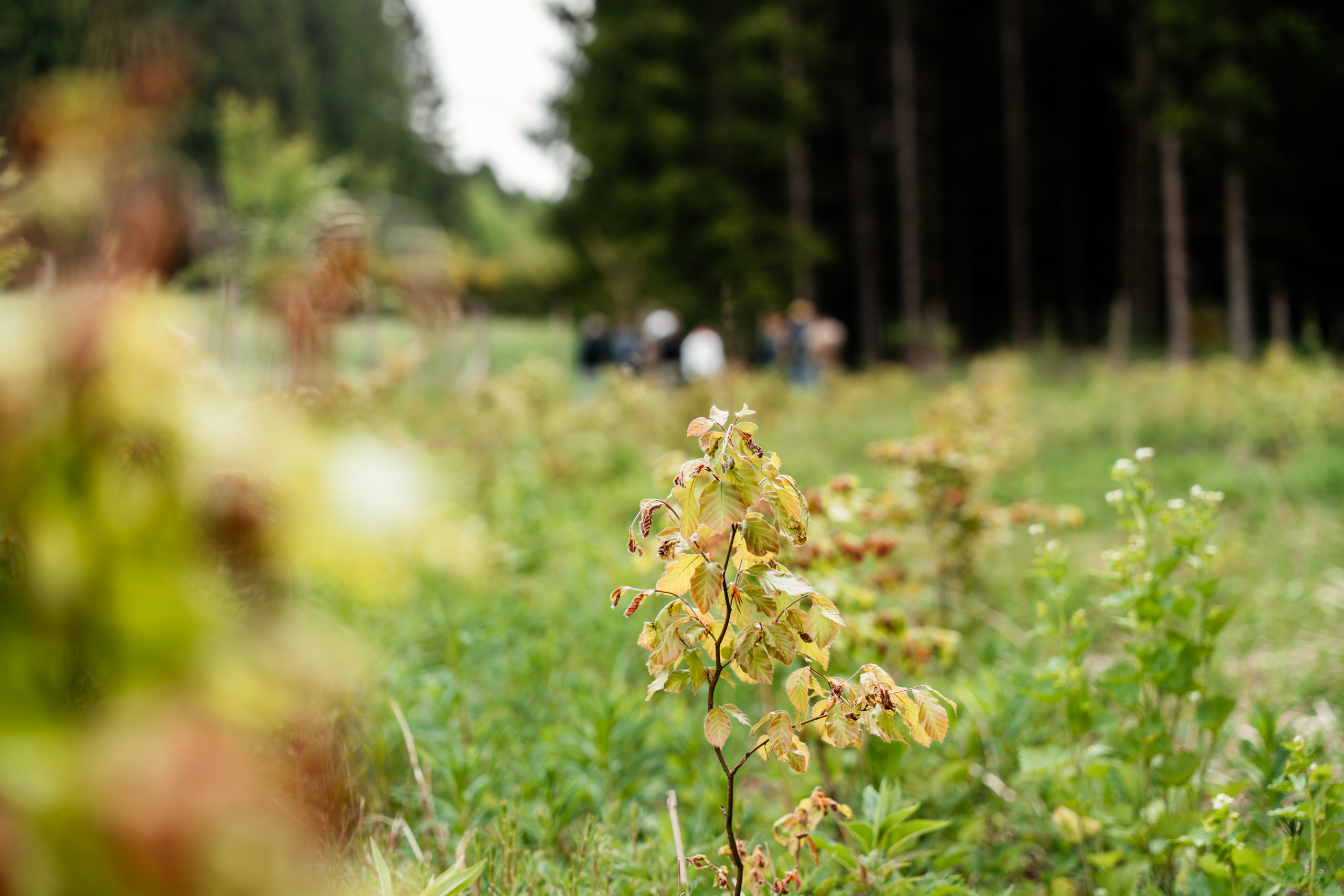
Additionally, well-distributed natural regeneration is present (birches, oaks, and Douglas firs)


Visit of June 5, 2026
The visit on June 5, 2026, revealed an excellent recovery of the various species, despite particularly drying xeric slopes. The mild spring clearly favored the establishment of the young plants.
The clearing of vegetation around the trees was underway during our visit; it is now completely finished, ensuring the plants receive adequate light.
At the bottom of the plot, we identified a small spring. Examination of old maps reveals that it was once a public fountain, active during the first half of the 19th century, at a time when the site was not yet forested.
The owner has the ambition to further open up this spring head, in order to:
- strengthen local biodiversity,
- provide a water source for wildlife,
- and bring this discreet but remarkable heritage element back to life.
This perspective integrates harmoniously into the ecological dynamics of the site.
This plantation has a promising future!


Forest
-
Planting / installation period2025
-
PEFCNo
-
Number of trees3 730
-
Area35 000 m²
-
Carbon324 T of carbon sequestered over 30 years
List of selected species
| Cedrus atlantica | 1000 |
|---|---|
| Pinus sylvestris L. | 810 |
| Pinus nigra var. corsicana | 890 |
| Pinus brutia Ten. | 30 |
| Carpinus betulus | 350 |
| Tilia cordata | 100 |
| Sorbus torminalis | 100 |
| Malus sylvestris | 50 |
| Pyrus pyraster | 50 |