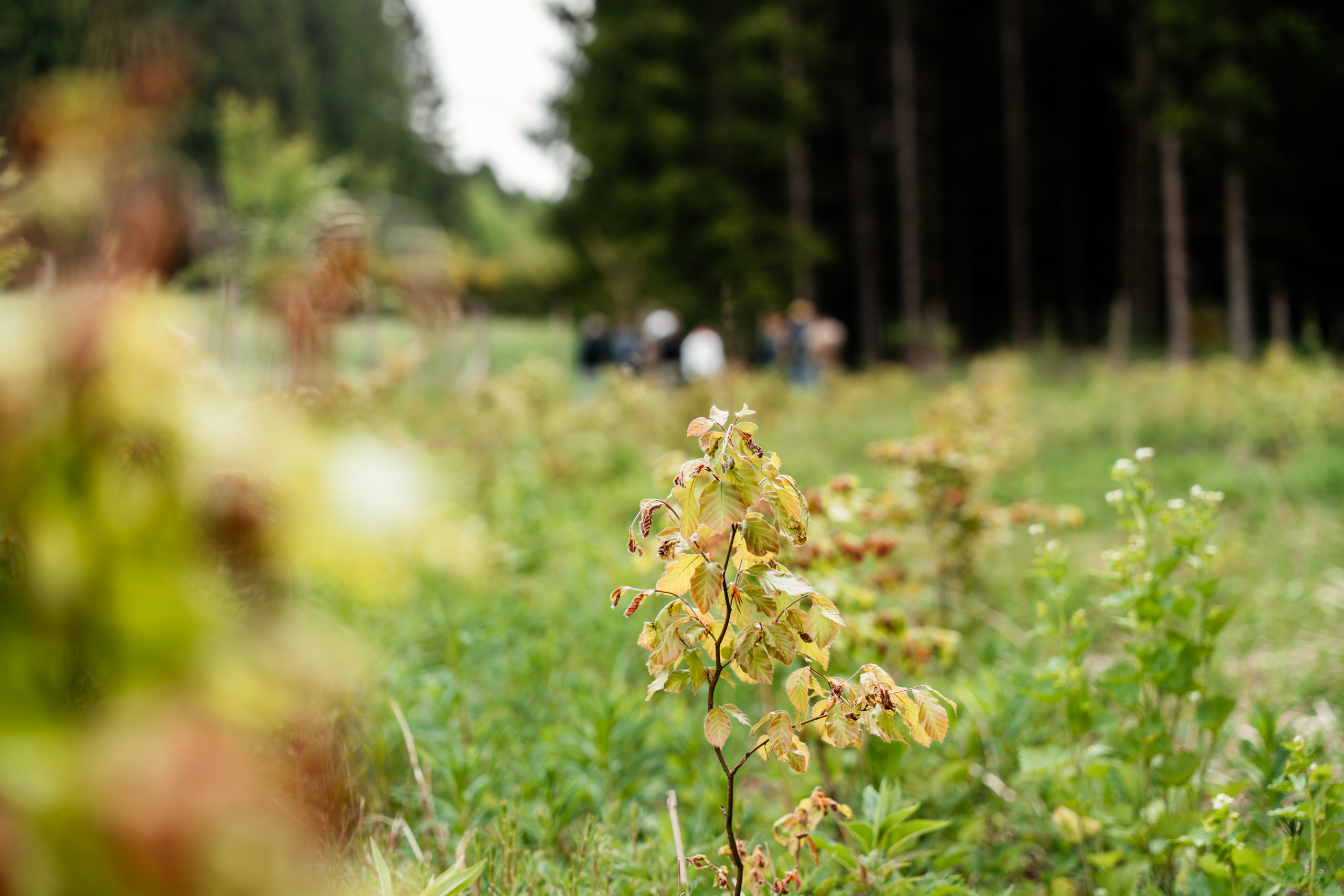
Noëlla and Léon are pursuing ambitious projects in favor of biodiversity. This project involves 460 meters of double-row hedge at Delcourt Farm, or approx. 1300 plants. All the elements are in place to recreate shelter, cover, and wildlife corridors in the agricultural plains of Gembloux.
An Orchard for Biodiversity & Climate at Delcourt Farm
Noëlla and Léon, Farmers at Delcourt FarmNoëlla and Léon initiated the project. Informed of our existence by a neighboring farmer, they shared their overall ambition and their desire to plant 460 meters of double-row hedges.
The Story of Noëlla & Léon – Delcourt Farm
Our two farmers operate the small family farm of 30 ha, taken over from Léon’s parents. The farm has been converted to organic since 2015. These are mainly meadows. On the rest of the area, they cultivate, for example, beans (processed in an organic cannery) and cereals (triticale, spelt/pea mixtures for fodder, or bread wheat (for bread making)).
In the middle of the meadow-orchard, a mobile chicken coop designed by Léon & Noëlla can be found.The ambition does not stop there. They must put Nature back at the center of their farm. That is why they are working for the ecological network of Gembloux. Furthermore, Noëlla is a graduate in beekeeping and aims to establish some hives, primarily with the goal of protecting bees. All flowers and fruits present serve as shelters and food sources for pollinating insects.
In 2020, the Delcourt family established a meadow-orchard of 120 fruit trees. In 2023, we jointly organized the planting of their double-row hedge.
Illustration of the Meadow-Orchard in Summer 2022
What a Story… Of Trees and Hedges!
Following the complete visit of the plots, 3 hedge sections totaling 460 meters of double-row hedge were confirmed. As a result, more than 1,300 plants will grow in Sauvenière, in autumn-winter 2023/2024.
Planting of the Future Hedge in Sauvenière (Gembloux)First, the planting is carried out after mechanical removal of grass to facilitate the use of thermal augers. Selected plantspecies promote the nourishing aspect of the green infrastructure (pollen and fruits) throughout the seasons. True enthusiasts, Noëlla and Léon observe various bird species, including house sparrows and tree sparrows, blue tits and great tits, black redstarts, Eurasian jays, etc., who will find an ideal nesting place.
Léon has already planted hedges on his land.In conclusion, the hedge also contributes to improving soil and water quality, but also to carbon sequestration in the soil over 20 years, so that planting 1 meter of hedge sequesters 117 kg of CO2 over 20 years. Indeed, let us remember that together, we are preparing agriculture’s resilience to climate change,
View of the Area Positively Impacted by the Hedge.
Now, it is accomplished! Thanks to a fantastic team, the hedge was planted properly.
It was in rainy and freezing cold weather that we went to see how the planting was progressing.
Courageously, the planters were in sweaters while our new colleague, Camille, was bundled up under layers of coats. Thanks to Léon and Noëlla for lunch and this wonderful moment of sharing!
The Planting Team Works Hard!In any case, the hedge, planted around the perimeter of the orchard, is truly welcome…On the one hand, it helps to protect the orchard from the relatively frequent and intense gusts of wind where the farm is located, and on the other hand, it allows the bees from their hive to collect the precious nectar they use to make delicious honey in collaboration with a local beekeeper.
To meet the objectives of a melliferous and windbreak hedge, we planted 24 different species. Among these, we find black elder, sessile oak, field maple, common dogwood, hawthorn, small-leaved lime, and many others! We strategically placed them to limit competition between species and thus allow the hedge to develop as diversely as possible.
Visit with the companies to see the final result: nice, isn’t it?This will also contribute to the educational project that Noëlla is leading with students from surrounding schools to raise their awareness of current environmental and climate issues in a fun way.“Mom, how do bees make honey?” “Dad, why are we planting a hedge? Plus, there are plants that sting…”
Soon, they will know everything! 😉
Rang de haie
Fleur de viorne obier
Aubépines et visiteurs
Main objective
Ecological Network
Hedge
Planting / installation period
2023
Number of trees
1 300
Meters of hedge
461 m
Carbon
117 T of carbon sequestered over 20 years
List of selected species
Elderberry
Sessile Oak
Field Maple
Bloodtwig Dogwood
Hawthorn
Small-leaved Lime
Dog Rose
Guelder Rose
Hazel...
Interested in co-funding a project with other businesses?
Do you have land to enhance? A plot to transform? We are here to support you in your endeavor.
Pour offrir les meilleures expériences, nous utilisons des technologies telles que les cookies pour stocker et/ou accéder aux informations des appareils. Le fait de consentir à ces technologies nous permettra de traiter des données telles que le comportement de navigation ou les ID uniques sur ce site. Le fait de ne pas consentir ou de retirer son consentement peut avoir un effet négatif sur certaines caractéristiques et fonctions.
Fonctionnel
Always active
L’accès ou le stockage technique est strictement nécessaire dans la finalité d’intérêt légitime de permettre l’utilisation d’un service spécifique explicitement demandé par l’abonné ou l’utilisateur, ou dans le seul but d’effectuer la transmission d’une communication sur un réseau de communications électroniques.
Préférences
L’accès ou le stockage technique est nécessaire dans la finalité d’intérêt légitime de stocker des préférences qui ne sont pas demandées par l’abonné ou l’internaute.
Statistiques
Le stockage ou l’accès technique qui est utilisé exclusivement à des fins statistiques.Le stockage ou l’accès technique qui est utilisé exclusivement dans des finalités statistiques anonymes. En l’absence d’une assignation à comparaître, d’une conformité volontaire de la part de votre fournisseur d’accès à internet ou d’enregistrements supplémentaires provenant d’une tierce partie, les informations stockées ou extraites à cette seule fin ne peuvent généralement pas être utilisées pour vous identifier.
Marketing
L’accès ou le stockage technique est nécessaire pour créer des profils d’internautes afin d’envoyer des publicités, ou pour suivre l’utilisateur sur un site web ou sur plusieurs sites web ayant des finalités marketing similaires.