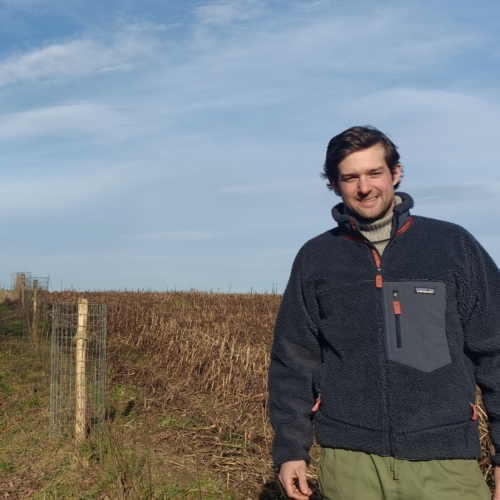
Let’s talk a bit about Hex Farm
Hex Farm is a family farm whose sustainability has been ensured for 3 generations, and whose mission is to maintain the landscape typical of the Limburg Hesbaye. This landscape is characterized by its gentle undulations where traditional orchards, pastures, small woodlands, and cultivated plains intermingle.
Hex Farm is a mixed farm that combines cattle farming, cereal and beet cultivation as well as standard-stemmed fruit trees. The rearing of beef cattle is managed in an extensive manner (organic certification) and integrates the entire value chain in an ultra-short supply chain. Crops are managed with an emphasis on agro-ecological practices (no-till, complex green manures, highly reasoned use of chemical inputs, etc.). Furthermore, this project is being realized thanks to our partnership with Farming For Climate.
After a career of about 10 years in the agri-food sector, I had always harbored the ambition to undertake a project in this sector. The family farm, in need of new energy, proved to be the ideal opportunity with interesting potential for improving the value chain and cultivation practices. Joseph d’Ursel, farmer.
Why hedges?
Within the farm, agriculture, nature (biodiversity, soil and water health), and the landscape are seen as a whole, as a single ecosystem. For Joseph, nature has a great deal to offer agriculture and the landscape, and vice versa. Tens of kilometers of hedges, about fifteen hectares dedicated to the preservation of old standard-stemmed orchards, all cultivated plots surrounded by grass strips, and 10% of crops dedicated to biodiversity (specific mixes for plain birds and insects, unmown) are among the practices Hex Farm has implemented or continued. And Joseph insists: “There is always room to continue, so we won’t stop there.”
Project Description
This is a multiple project. This means that not all sections are located in the same place. Let’s explore Joseph’s ambition together.


Sections 1 and 2, bordering cultivated land, will consist of a shrub layer but also tall specimens approximately every 10m. Sections 3 and 4, in pasture (cattle), will consist solely of shrubs. The hedges will be protected from livestock.
In total, 1,235 m of hedges and 42 trees will be planted.
Characterization Visit
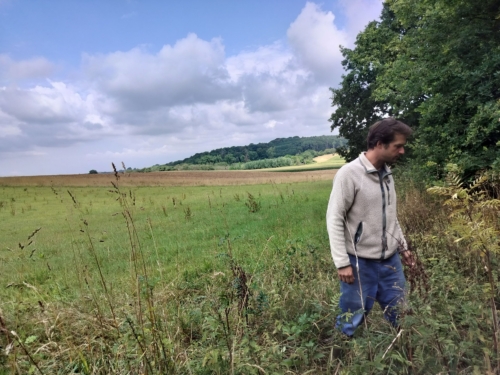
Some field photos from the characterization visit in July 2025. In October 2025, a new visit will take place to confirm the linear layout with the planter. For this project, our call for tenders resulted in the selection of a local adapted work enterprise, supporting the reintegration of individuals facing difficulties accessing the traditional job market.
During the visits, Joseph reiterates that the project makes sense because the sections contribute to a strong ecological network in the region, connecting with sensitive areas such as Natura 2000 sites nearby.


-
Multiple hedges in HeersLearn more
Handover of the planting works
In January 2026, we were able to confirm the successful completion of the planting: here are a few images.


Verification visit
The visit on May 21, 2026 to Joseph confirms a very good recovery of the shrubs planted on the various plots. As droughts are always a risk, we had not insisted on the need to mow the areas around the hedge. At the end of May, we were able to give Joseph authorization to carry out the maintenance to clear the plantings minimally.
The checks carried out show particularly high recovery rates, with the following percentages:
- H1: 96%. We also note a slight appetite from deer despite the protections.
- H2: 82%. It was mainly the willows that suffered from herbivore attack (slugs and/or caterpillars).
- H3: 97%.
- H4: 90%.
These results demonstrate a successful establishment, despite the sometimes demanding site conditions. The diversity of species and the quality of the planting work clearly contribute to this positive dynamic.


Hedge
-
Planting / installation periodJanuary 2026
-
Number of trees1 806
-
Meters of hedge1 235 m
-
Carbon87.8 T of carbon sequestered over 20 years
List of selected species
| Guelder Rose | |
|---|---|
| Purple Willow | |
| Bloodtwig Dogwood | |
| Hazel | |
| Single-style Hawthorn | |
| Sessile Oak | |
| Wild Service Tree | |
| Field Maple | |
| Norway Maple | |
| Chestnut tree | |
| Rowan | |
| Small-leaved Lime |
PlantC offers me the opportunity to implement even more measures that boost biodiversity on my farm. This biodiversity ultimately makes the entire system healthier. Less erosion, more insects… a better balance that enables better yields with fewer inputs. Without this support, I would not have been able to complete this project in such a short timeframe (I would have had to budget for it over several years and in multiple stages). The method is highly appreciated because it requires very little time from the farmer, thanks to their experience and flexibility, while still allowing the farmer to remain ‘master’ on their own land with very few constraints.