Laide-Basse Farm
Jean-Yves Moens is a farmer in Fosses-la-Ville; he contacted us because he wishes to plant future Trognes (= or pollard trees) around the edges of his meadow.
Jean-Yves Moens’ farm is diversified: It focuses on market gardening, livestock farming, and agricultural product processing workshops. He raises meat sheep there and has also developed a hospitality activity with several guest rooms, as well as horse boarding.

Jean-Yves contacted us to plant pollard trees on his plot for 3 reasons:
- To provide shade and fodder for his sheep.
- To regulate water at the plot level: pollard trees play a role in water management by absorbing excess moisture.
- To produce wood: Regularly cut branches provide firewood and materials for crafts, without requiring the felling of the entire tree. This is a sustainable natural resource management practice.
The future Trognes will naturally regulate water at the plot level, while maintaining the potential and quality of the wetland waters in the lower part of the land. As wetlands become increasingly rare, we strive to convince our farmers to preserve these areas and plant suitable species.
Finally, they will restore diversity to our rural landscapes. This plot demonstrates that existing features can be enhanced to create an environment favorable to biodiversity and rich in history.
Visit and Analysis
We met in February 2025. The agenda included soil analysis and pH testing to propose a suitable composition.


In total, 110 pollard trees will be planted this winter 2025-26.
Trognes, an Ancient, Sometimes Forgotten Agricultural Practice
Trognes are much more than just trees. They are remnants of ancient agricultural practices almost forgotten in our time. They provide fodder for livestock, reduce soil erosion, and offer shade to cattle. But these are not the only services they provide to humans.

Pollard trees are reservoirs of biodiversity. The cavities and fissures in the trunks of pollard trees offer precious habitats for a multitude of species. They shelter birds, insects, mammals, and fungi, thus contributing to local biodiversity.
-
Pollard Trees at Laide-Basse FarmLearn more
AND the Planting, What’s the Outcome?
On November 27, 2025, we visited the site with Jean-Yves and Paul, who put in a lot of effort for the EKIUM team.
An opportunity to discuss projects around Jean-Yves’ farm, who will let about sixty Shropshire sheep graze on the plot.


After an overly mild autumn, we had to wait until the end of the month to reach seasonal temperatures.
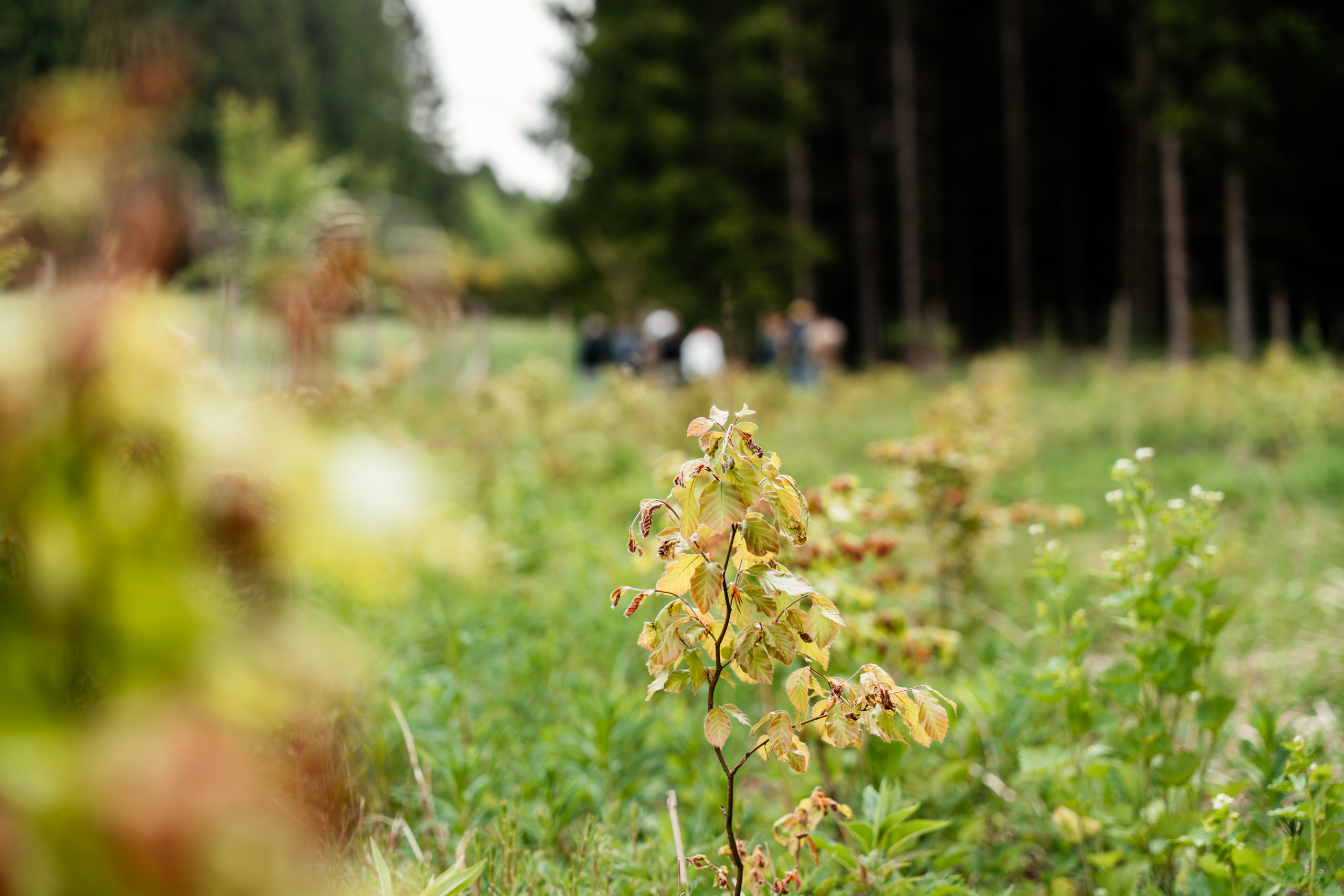
The planting team implemented the main species (hornbeam, lime, and white willow). In early December, the 11 black poplars and deer protection will complete the project…
Agroforestry
-
Planting / installation period2025
-
Number of trees110
-
Area1 919 m²
-
Meters of hedge640 m
List of selected species
| Small-leaved lime – Tilia cordata | 11 |
|---|---|
| White willow – Salix alba | 44 |
| Common hornbeam – Carpinus betulus | 44 |
| Black poplar – Populus nigra | 11 |