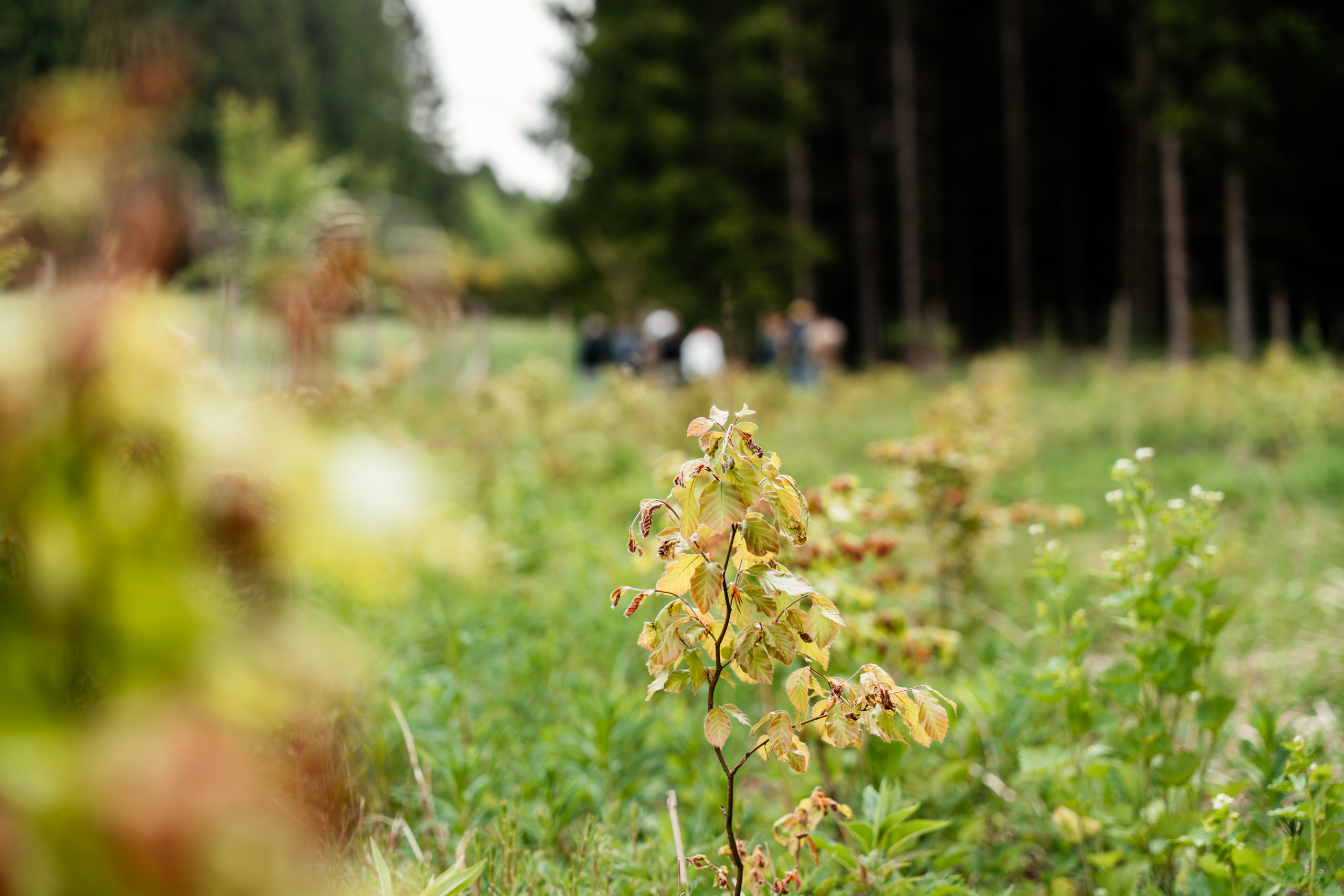
In Denée, this is a sanitary reforestation after selective felling due to bark beetle attacks. This program supports the planting of 2,000 trees. Nine species were planted over 2.13 hectares.
DENEE: REFORESTATION FOR CLIMATE AND BIODIVERSITY
- Planting period: Autumn 2021.
- The survival rate was checked in autumn 2022.
- 305.3 tonnes of CO2 sequestered over 30 years.
The forest management is PEFC certified.
Species diversity contributes to biodiversity preservation thanks to melliferous species and the fruits that will be produced (acorns, for example). The selected species produce a leaf litter that decomposes properly, helping to improve the fertility and life of the forest soil. The roots also help to stabilize the soil substrate.
This project is carried out in partnership with the Royal Belgian Forestry Society.
-
Reforestation in DenéeGet inspired
VISIT TO THE PLOT IN DENEE IN 2023
On May 16, 2023, the forester warmly welcomed us to the recently reforested plot. Very quickly, as we covered the short distance between our meeting point and the project, we observed the remnants of damage from the 2021 storms. The area is heavily traversed, naturally, by water sources. Nevertheless, the intensity of the summer 2021 rains was unprecedented. The ecosystems could not absorb this shock. The basin and irrigation system previously put in place at the time are no longer suitable today. The storms now bring a significant volume of water in a single sequence. In the past, rainy events were less violent and more spaced out. Furthermore, on the plot we are concerned with, the water table is less than 10 meters deep from the surface.
Before arriving at the plot we are concerned with, we walked through other wooded areas that have been there for varying lengths of time. It was then that we became aware of the different management approaches depending on the area. As the forester explained: “The Earth provides what is needed; one must know how to work with it.”

Due to the presence of water in the soil, the forester then explained why he must always plant at the beginning of winter. Neither too early, nor too late! Finally, the site characteristics favor the use of deciduous species. Old conifers are present, and the manager naturally allows this coexistence because the aim is precisely to test different management approaches. The soil is calcareous, so the most important thing is to mix the tree populations. Furthermore, regarding the Byzantine hazelnut, it is also a small experimental stand of 16 individuals, proposed under the advice of the forest manager.

DENEE, AN EXEMPLARY MANAGEMENT
A very original and interesting fact: the forester calls upon the scouts to help him with the maintenance of the plots. This is a good compromise during camps, but above all, passion and knowledge are passed on. Furthermore, our host is a forest guide, a real asset in raising user awareness! On average, the forester spends at least one day a week in his forest plots. Nevertheless, he is assisted by the manager for the monitoring of the forest stands.


Herbivore pressure is significant, which is why a fence surrounds the young forest stand. This is to protect the plants from damage caused by roe deer and wild boar. Good news and bad news: the hare is returning to the region, but it passes under the fence. However, it must be noted that herbaceous flora is also present on the site, benefiting from the increased light in the area.
We address the famous question of the ash tree. Indeed, this species is threatened by pests. Nearby, the remaining individuals are falling one after another. This is why the forester has decided not to replant them. Furthermore, for the same reasons, the species is becoming increasingly difficult to find in nurseries.
Very importantly, across the entire forest area, only this plot is not classified as a Natura2000 zone. Nevertheless, its management is PEFC certified.
We left very happy and delighted to have met this very conscientious beneficiary. Thank you to him for his trust, and thank you to you for your support in this reforestation project.
Forest
-
Planting / installation period2021
-
PEFCYes
-
Number of trees2 000
-
Area21 300 m²
-
Carbon305.3 T of carbon sequestered over 30 years
List of selected species
| Betula pendula - Silver birch | 333 |
|---|---|
| Tilia cordata - Small-leaved Lime | 167 |
| Malus sylvestris - European crab apple | 33 |
| Pyrus pyraster - European wild pear | 33 |
| Prunus avium - Wild cherry | 167 |
| Quercus petraea - Sessile Oak | 417 |
| Castanea sativa - Sweet chestnut | 417 |
| Corilus corluna - Byzantine hazelnut | 16 |
| Quercus rubra - American Red Oak | 417 |