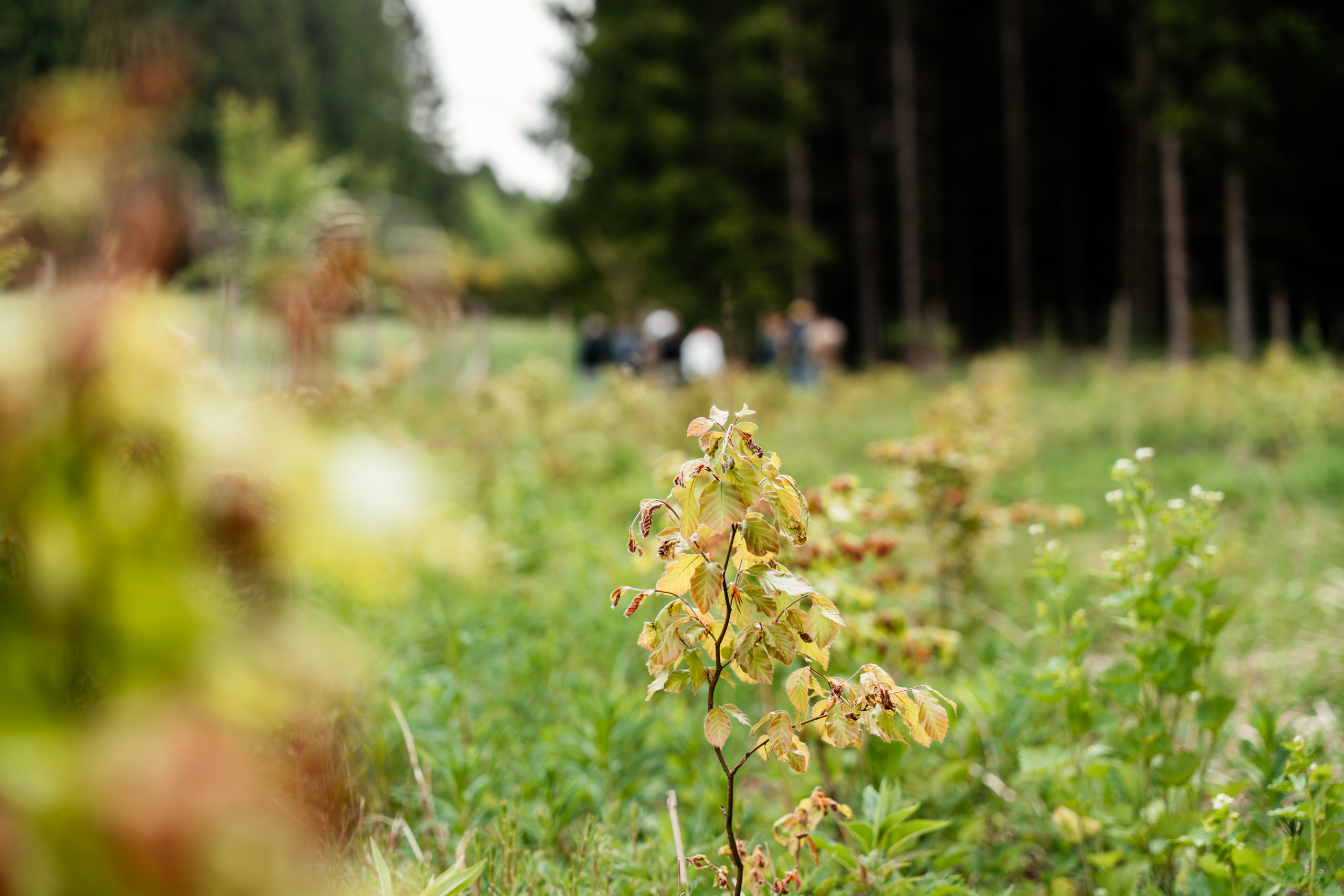
This is a diversification reforestation project where 5 species were planted over 1.06 hectares:
- Spruce (Picea abies) – 1,390 individuals.
- Beech (Fagus sylvatica) – 245 individuals.
- Hybrid Larch (Larix x eurolepis) – 212 individuals.
- Alder (Alnus sp) – 73 individuals.
- Sessile Oak (Quercus petraea) – 80 individuals.
In total, 2,000 trees were planted with the support of PlantC.


- Planting period: Spring 2021
- The survival rate was checked in autumn 2021.
- 282 tonnes of CO2 sequestered over 30 years.
This project is carried out in partnership with the Royal Belgian Forestry Society.
-
Reforestation in LibramontGet inspired
Visit to the plot in 2022
July 20, 2022, Pol awaited us in the village to easily guide us to the forest plot, located just a few kilometers away. Upon arrival, the forester had carefully prepared the planting plans for us. Very quickly, we set off to explore the area.
We realized that Pol is a true native of the region! He was born on a farm we had passed just a few minutes earlier.
What we appreciate here is the synergy between the forester and their forest manager. And how this collaboration leads to rigorous management of reforestation efforts. For example, part of the wooded area was colonized by a beetle called the pine weevil. To limit its spread, the manager was present on site every week to apply a non-residual treatment.
We also talked about birds! Pol informed us that the common raven is present on the site. In the background, we also heard the cry of a heron. Finally, he explained to me that Ten years earlier, he had been able to observe two black grouse. He hopes to see them in the area again one day..
As the visit progressed, it became clear that Pol is a nature lover. Vigilant about the flora developing alongside his trees, he explained how his father had already passed on to him the practice of reasoned management at the time: breaking the fern but leaving it in place, avoiding continuous mowing to retain soil water (limiting evaporation).
Regarding soil characteristics, it is interesting to note that the plot remains relatively moist. Nevertheless, foresters must manage the soil heterogeneity, which can sometimes be shallow with the presence of clay (impermeable clay soils) and soil with a variable depth from 30 cm to more in certain areas.
The spruces he had to harvest were planted by his father in the 1950s. Pol was always there, but paradoxically, his passion for the forest and its environment came much later!
“Summers are hot but winters are very cold; there’s no choice but to reconcile environment and silviculture!” This is how the forester explains his choice for diversified reforestation. It involves layering the reforestation but also playing on different longevities.
Herbaceous flora is important for wildlife! For example, he leaves flowering plants (thistles), and goldfinches will come to eat the seeds.


During the preparation of the plot, the wood chips were left on site to re-enrich the soil. Another alternative would be to collect it to make pellets, but this is not his primary choice, as he prefers that the elements return to the soil and wishes to avoid the passage of overly heavy machinery.
A small anecdote that only 100% empirical management can provide: the use of 3 bamboo stakes around the larch: at reduced cost, this trick prevents deer from damaging the tree! Many professionals did not believe it. However, it is clear that the technique works on this land!
We leave Pol, this passionate individual, with these few words: He is happy and proud when he sees his trees grow and often thinks of his father. But there is no secret; a balance between yield and biodiversity is necessary!
Forest
-
Planting / installation period2021
-
PEFCNo
-
Number of trees2 000
-
Area1 m²
-
Carbon282 T of carbon sequestered over 30 years
List of selected species
| Spruce (Picea abies) | 1390 |
|---|---|
| Beech (Fagus sylvatica) | 245 |
| Hybrid Larch (Larix x eurolepis) | 212 |
| Alder (Alnus sp) | 73 |
| Sessile Oak (Quercus petraea) | 80 |