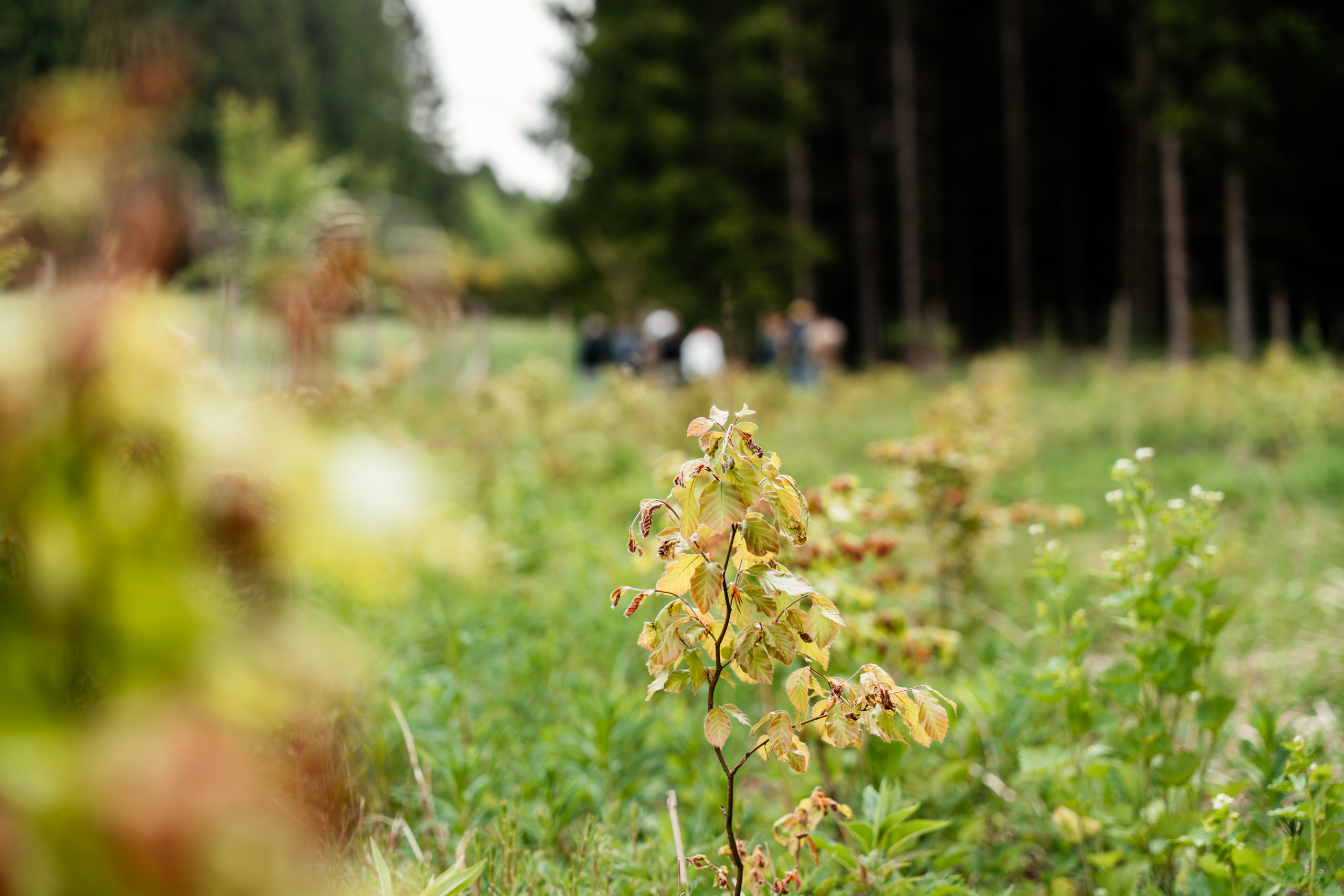
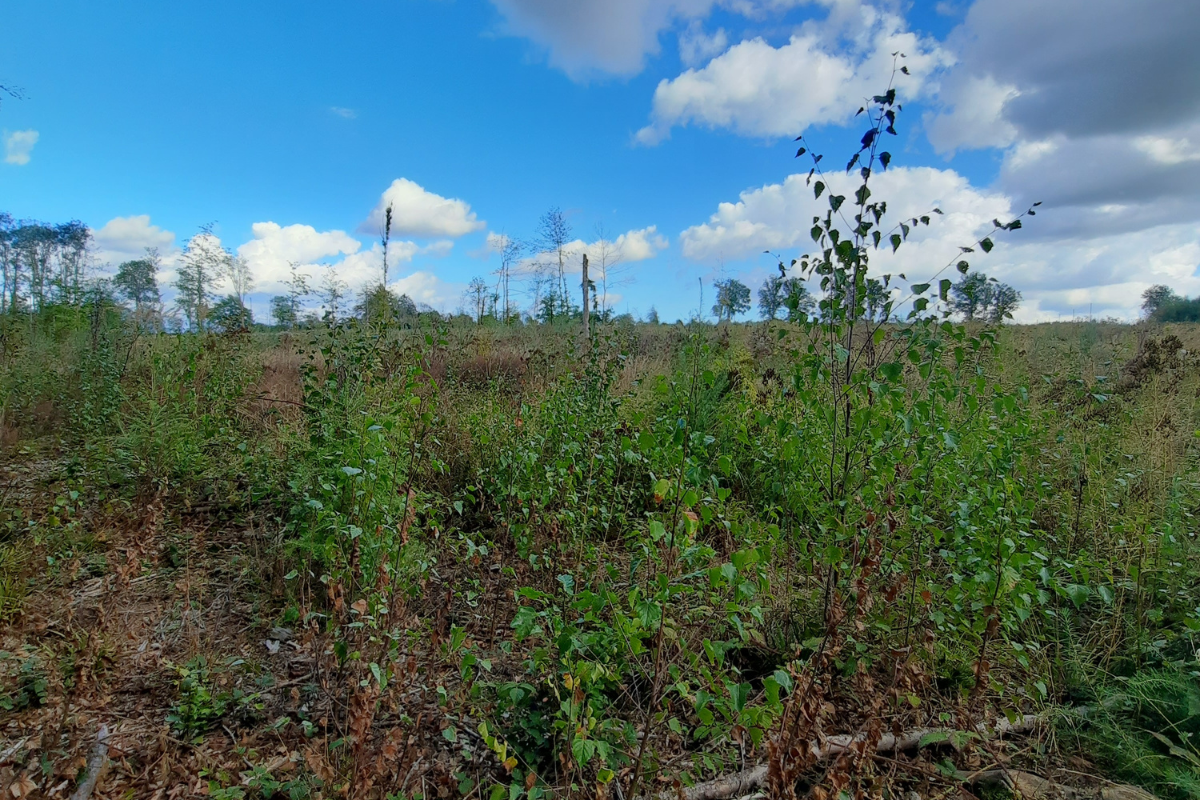
The Ouffet Reforestation in Detail
This is a reforestation project of 2,000 trees. Five species have been planted. The reforestation management is PEFC certified.
Using a diversity of species is beneficial for birdlife (e.g., flowers, fruits, and acorns, which are food sources for birds, insects, and small mammals). When leaves fall, humus is generated, and root systems are complementary. This will impact the recycling of deep elements, the biological activity of the soil, the fixation and structuring of the soil.
- Planting Period: Spring 2021.
- The recovery rate verified in autumn 2022: compliant >80%.
- 274.3 tonnes of CO2 sequestered over 30 years.
The management of this project is PEFC certified.
Project carried out in partnership with the Royal Forestry Society of Belgium.
-
Reforestation in OuffetGet inspired
Visit to the Ouffet Plot in 2023
I am welcomed by Mr. Pierre Peltzer, a trained economist who took over the family farm, consisting of cultivated land and forest plots. The plot we are concerned with here spans 2.1 Ha and is part of the principles of the mosaic forest.
Here we have a majority of deciduous trees, making up nearly 70% of the stand. Game pressure is significant in the region; here, the forester protects the trees with individual protective sleeves and stakes.


The Organization of the Reforestation
This is a reforestation project that is part of a diversification strategy, while taking care not to destabilize existing stands against prevailing winds. Despite some losses due to vandalism and climatic/game factors, the stand is a real success with a recovery rate exceeding 80%.
The plot is composed of 2 blocks:


We are in the heart of Condroz, with silty soils exhibiting favorable natural drainage:
- Trophic level (availability of mineral resources): meso-oligotrophic (acidic soil).
- Hydric level (availability of water resources at the site): mesic. We have a regular supply of soil water and good aeration.
To the East, the stand consists of sessile oaks and larches.
We also find natural regeneration there, with numerous birch trees (pioneer species). Birch has a positive impact on the forest ecosystem; it facilitates the establishment of other species.
Sessile oak tolerates acidic sites. It has a powerful root system and good potential in the face of climate change.
The larch, with its light and deciduous canopy, promotes the development of the undergrowth’s carrying capacity. This is beneficial for both fauna and flora.


To the Northwest: red oaks, sycamore maples, and beeches.
The rows are spaced 2.5 meters apart, and the plants are 2 meters apart. Between the rows, Pierre chose to plant beeches. This helps promote stem formation.
Sycamore maple quickly produces wood for quality sectors (e.g., lutherie, cabinetmaking). Its impact is positive on the forest ecosystem (rapid decomposition of leaves, high carrying capacity, good shelter species for fauna).
The American red oak is less susceptible to diseases or pests. It also represents a future-proof species in the face of global warming and produces quality wood.


On the sidelines of the visit, the forester showed what he is implementing around his plot to enhance biodiversity: tree alignments, reforestation with future-proof species, free-growing hedges, low-trimmed hedges, etc.
A whole series of developments in favor of the ecological network in Ouffet!
Visit in 2024 with VO-Group
On May 22, 2024, we set off on an adventure. Pierre Peltzer arranged transportation for us to access the plot!
Pierre and Eloïse from VO-Group enthusiastically climbed into the cart. A few minutes later, we accessed the plot…


Forest
-
Planting / installation period2021
-
PEFCYes
-
Number of trees2 000
-
Area21 000 m²
-
Carbon274.3 T of carbon sequestered over 30 years
List of selected species
| Quercus petraea | 312 |
|---|---|
| Quercus rubra | 203 |
| Fagus sylvatica | 610 |
| Larix eurolepsis | 687 |
| Acer pseudoplatanus | 188 |
Since 2021, VO Group has partnered with PlantC. We cannot speak highly enough of this company: their purpose, the professionalism of their team, and their genuine interest in the living world are all truly positive.