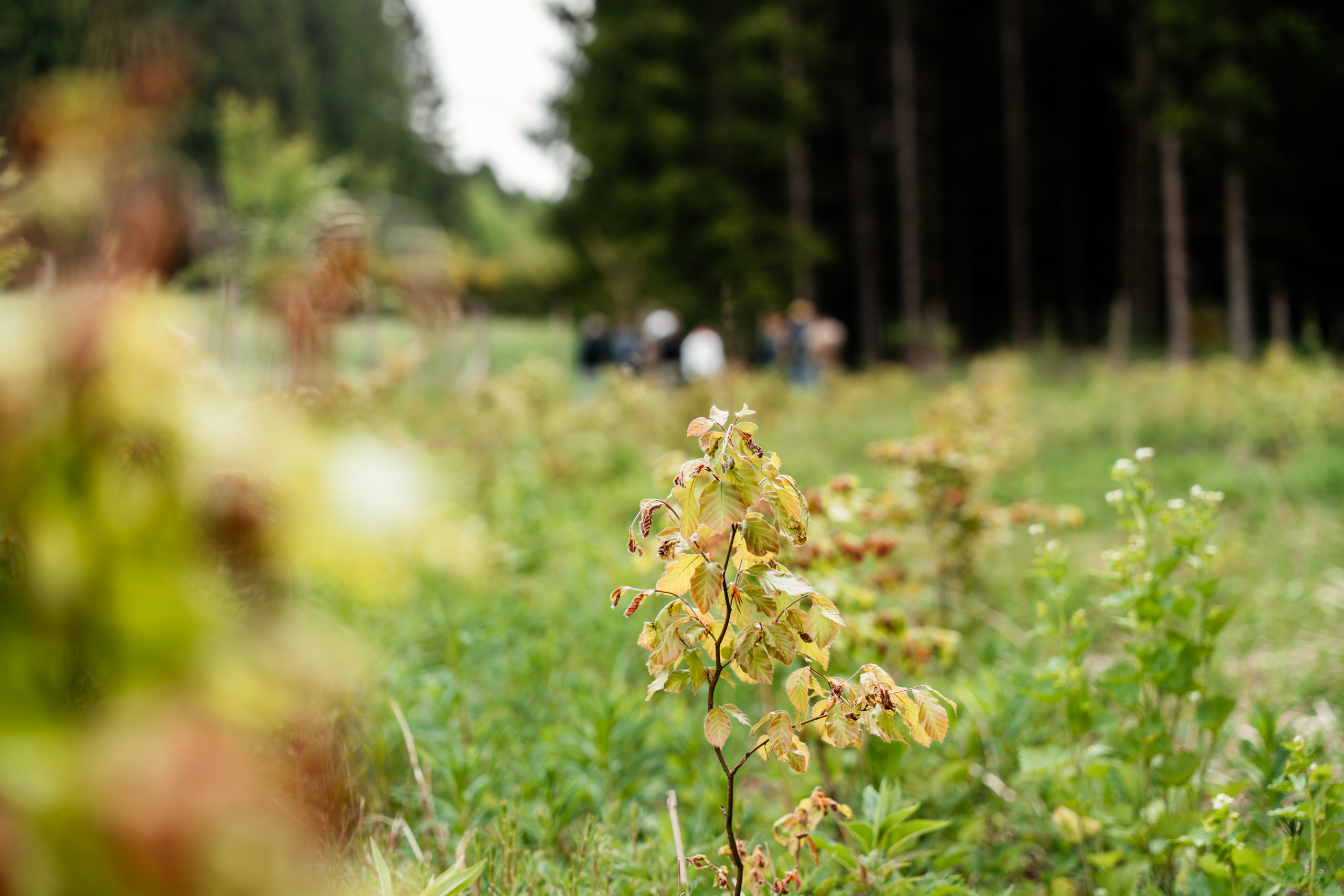
This is a restorative reforestation after total windthrow following localized clearing due to bark beetle attacks. This program aimed to support 2,000 trees.
Project Details
Three species were planted: 1,462 spruces (Picea abies), 385 Douglas firs (Pseudotsuga menziesii), and 154 birches (Betula sp.).
- Planting period: winter 2020-2021
- The survival rate was checked in autumn 2021.
- 236.86 tons of CO2 sequestered over 30 years.
The selection of 3 species contributes to a program promoting biodiversity. The attractiveness to wildlife and plants varies from one tree species to another. Did you know that birch is a pioneer tree? Meaning it is one of the first species to colonize a disturbed environment? Birches are excellent hosts and contribute to maintaining soil quality.

The selected species produce a leaf litter that decomposes properly, contributing to improved fertility and life in the forest soil. The roots also help stabilize the soil substrate. Finally, Douglas firs and spruces generate wood and significant carbon sequestration.
This project is carried out in partnership with the Royal Belgian Forestry Society.
-
Reforestation in StoumontGet inspired
Visit to the plot in 2022
The forester welcomes us to the plot on this sunny day of June 22, 2022. He explains that his plot was damaged by the bark beetle 3 years ago. The remaining, weakened spruces did not withstand the succession of strong winds, which broke and uprooted them. The soil dries out, and spruce, with its very shallow roots, cannot tolerate drought.
Following the sanitary felling, there was therefore a reforestation project. The soil is poor, shaly, and acidic, and the climate is cold and rainy. Deciduous trees therefore have little chance on this plot. And given these site realities, it is difficult to further diversify the planting. This is why these 3 species mentioned above were selected beforehand.


A section planted with birches was destroyed during the winter of 2021-2022 by wild boar damage. Indeed, this part of the plot is near large oak trees: the wild boars were looking for acorns there! The objective is to partially replant this section.
Douglas fir is valued for its wood but can also be attacked by biotic factors. It is also very palatable to game. It was therefore planted less densely. Note that this plantation adjoins a very large Natura 2000 area: more than 25 hectares are deciduous coppice, among which birch holds a very prominent place.

Additionally, the selected woody species impact the light conditions under the foliage cover, as well as soil characteristics, which allows for the expression of adapted flora (litter decomposition, acidity, nutrient availability). The herbaceous flora under these trees will also serve as a refuge and food source for insects, birds, mammals, etc. Proof in photos: notice these beautiful flower stalks! These are purple foxgloves. The visit is therefore a real treat for the eyes but also for the ears (buzzing of pollinating insects, birdsong, etc.). Finally, the forester explains how his plantation coexists with natural regeneration. Indeed, the latter can express itself, such as the rowan, which is very interesting for granivorous and frugivorous avifauna.
In conclusion, the plantation, closely monitored by the forester, is therefore progressing well!
Help us protect the Belgian forest. Did you know that rules exist when you walk in the forest? Check our blog soon, information will be shared on this topic. Thus, this forest is not open to the public without specific authorization. Thank you for respecting and protecting the Belgian forest!
Forest
-
Planting / installation period2021
-
PEFCNo
-
Number of trees2 000
-
Area10 000 m²
-
Carbon236.86 T of carbon sequestered over 30 years
List of selected species
| Spruces (Picea abies) | 1462 |
|---|---|
| Douglas Fir (Pseudotsuga menziesii) | 385 |
| Birches (Betula sp.) | 154 |