


The Context
In Hamoir, this forest plot was historically dominated by ash.
Sanitary felling made necessary by ash dieback profoundly altered the stand, making way for a complete reconstitution of the forest.
Additionally, the plot contained a few pockets of bark beetle-infested spruce.
Rather than replanting identically, the choice was made for a differentiated strategy, adapted to the site conditions and the owner’s objectives.

Two Complementary Objectives
The reforestation project distinguishes two zones with different functions:
A production zone along the road. This section is fully replanted according to a structured scheme:
- Alternating lines of Douglas fir and Spruce
- A border of Koekelare Pine on the driest part
Spruce, although not strictly native to the site, plays a role here as a nurse tree for Douglas fir, promoting its straightness and growth dynamics.
The main objective is forest production, in a predominantly coniferous scenario.
An interior zone focused on diversification. Within the stand — in the wetter background and on the south-facing slope — the strategy is different.
Broadleaf cells are planted in the gaps left by the ash trees, following a scheme defined during the field visit.
Selected species:
- Sycamore maple
- Red Oak
- Pedunculate Oak
- Chestnut tree
- Small-leaved lime.
These cells have several functions:
- Diversify the stand structure.
- Provide food resources (acorns, chestnuts).
- Offer melliferous potential (lime, chestnut).
- Promote the recycling of minerals.
- Improve soil structuring and stabilization.
-
Rebuilding After Ash Dieback, Diversifying for the Future in HamoirGet inspired
A Mixed and Strategic Planting
In this project, we have 3 coniferous species and 5 broadleaf species.

The project’s logic is based on a combination of reasoned production, targeted diversification, and long-term resilience.
A More Robust Forest in the Face of Crises
The Hamoir project illustrates a current forestry reality:
health crises (like ash dieback) necessitate rethinking forest stands.
Here, the response is neither uniform nor radical.
It combines production, diversification, and adaptation to local conditions, in order to rebuild a more stable, functional, and resilient forest.
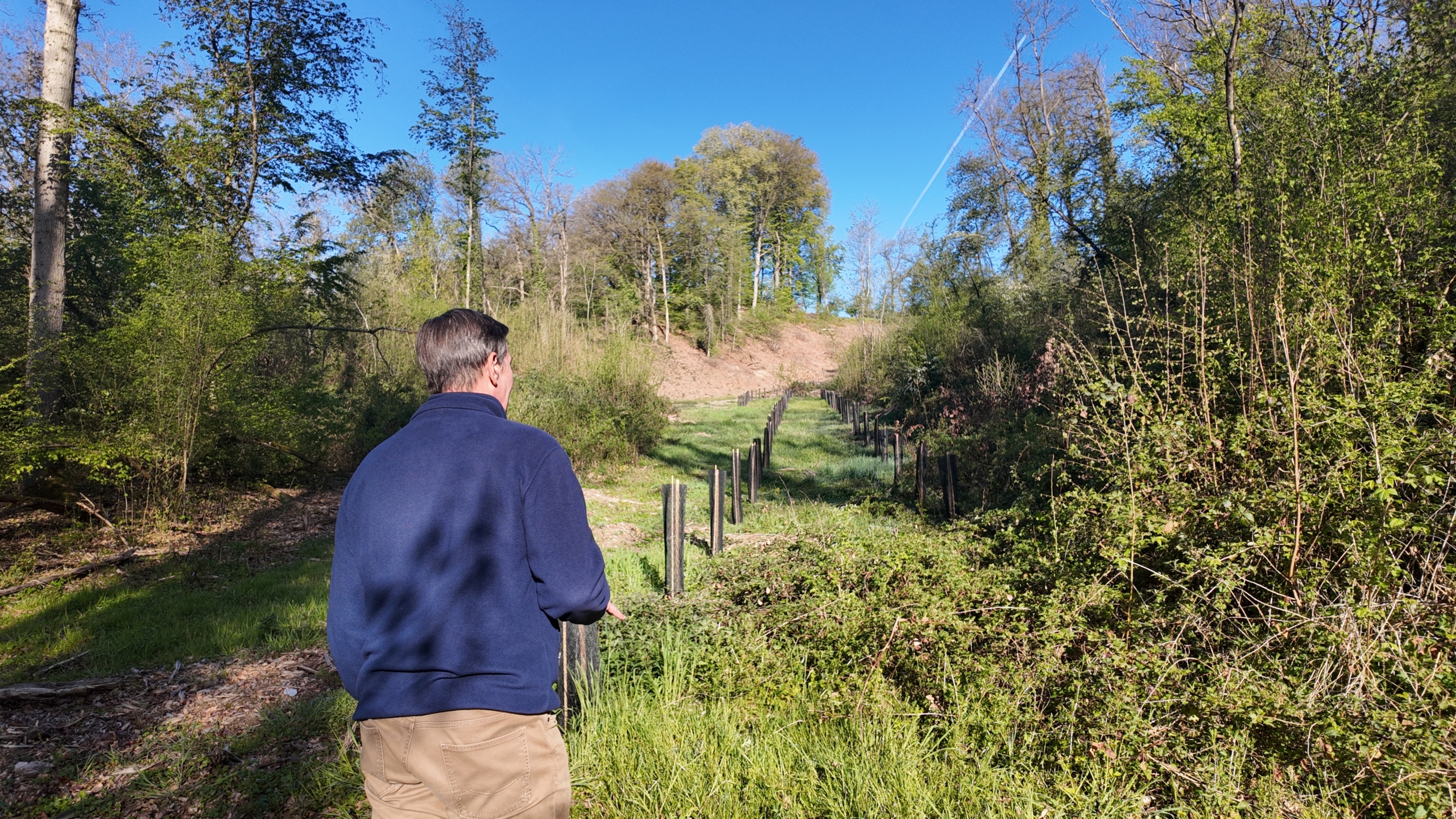


During the visit on April 24, 2025, we observed with the owner a magnificent survival rate (>80%). Although the owner has noticed the presence of a badger that enjoys digging up young plants (cohabitation is going well). For the record, this is why the forester visits the plot with his hoe.
In addition to the plantings, careful attention is paid to natural regeneration (maples and oaks), which is proving particularly promising on the plot.
Forest
-
Planting / installation period2026
-
Number of trees2 000
-
Area20 000 m²
-
Carbon600 T of carbon sequestered over 30 years
List of selected species
| Douglas Fir | 750 |
|---|---|
| Spruce | 750 |
| Koekelare Pine | 200 |
| Red Oak | 100 |
| Chestnut tree | 25 |
| Small-leaved Lime | 25 |
| Pedunculate Oak | 50 |
| Sycamore Maple | 100 |