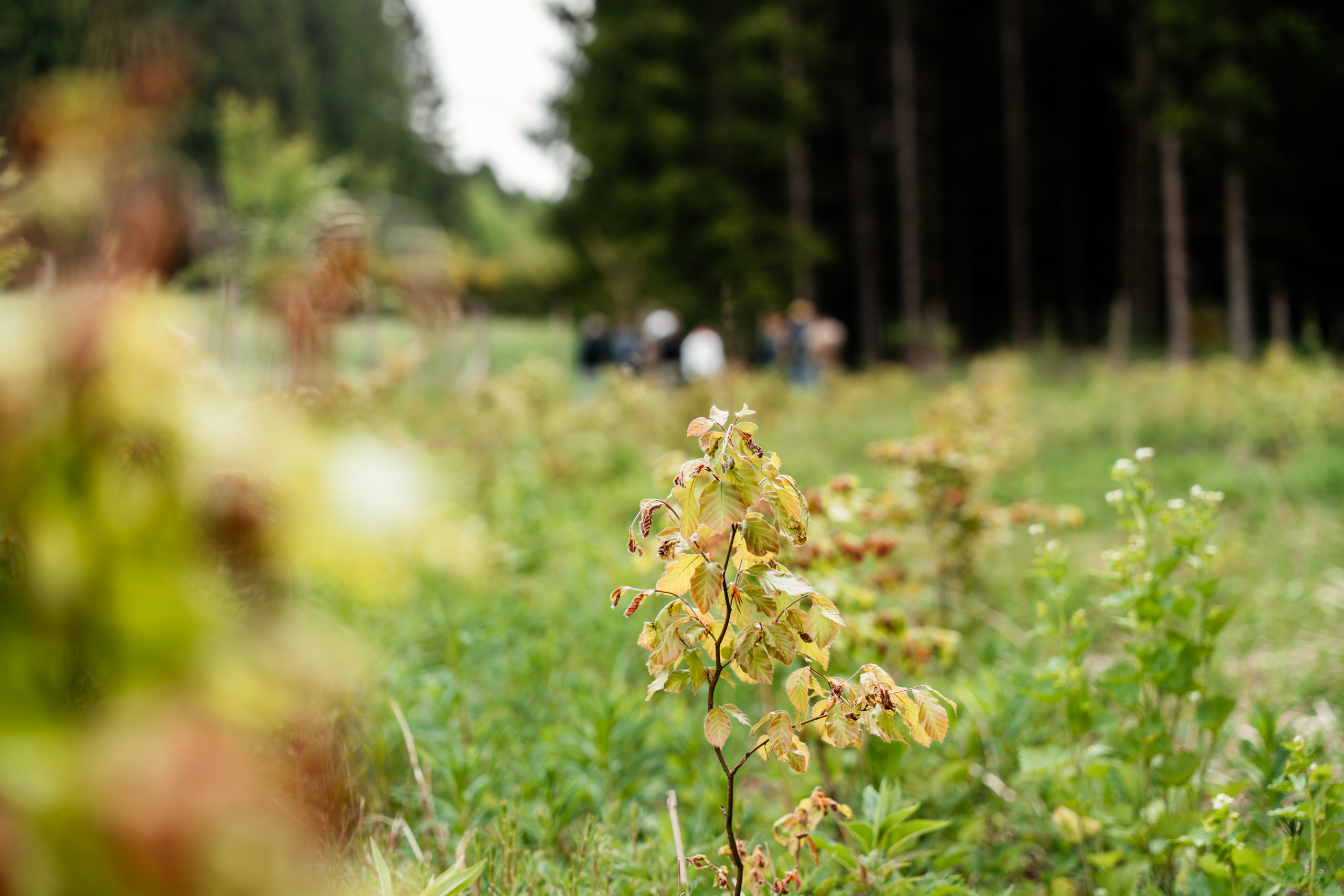
Let’s think about tomorrow’s forests
Since 2018, spruce, an iconic conifer of our forests and timber industry, has been experiencing a large-scale health crisis. Thousands of hectares are dying here and across Europe.
The cause? The bark beetle . This spruce-specific beetle is one of the biggest European forest pests. To combat it, it is crucial to remove affected trees. Now, add to this pest drought episodes, as well as winter storms.
As a result of this context, there is a fragility of forest stands and discouragement among many foresters, who often give up investing in the reforestation of their plots.
The SRFB partners with PlantC to support the reforestation of plots that have suffered a climatic or biological hazard, impacting the Belgian timber industry. The planting project helps make the forest ecosystem more resilient and resistant to hazards. The approach incorporates several species adapted to local conditions in a changing climate.
This project is carried out in partnership with the Royal Forestry Society of Belgium.
A plantation thoughtfully planned and sustainably managed
Here, in Andenne, 6 deciduous and coniferous species are planted across 1.45 hectares: birch, sessile oak, wild cherry, black walnut, chestnut, poplar. In total, 1,585 trees have been planted with the help of PlantC.
These species will replace a spruce monoculture destroyed by the bark beetle. This will guarantee and improve the services provided locally by the forest (biodiversity, water and soil quality). These are species with high biological potential (sessile oak) and beneficial for pollinators and birds (wild cherry). There is also natural regeneration of birches. Finally, these deciduous species have complementary root systems.
This involves carbon sequestration estimated at 286 tonnes of CO2 over 30 years.
-
The bark beetle-infested plot in Andenne has been reforestedGet inspired
Visit to the plot in 2022
PlantC was able to visit the Andenne plot on August 10, 2022, in the presence of the forest manager, Pierre-Olivier. The reforested area is located within a 50-hectare forest area.
The plot hosted spruces in the past. However, these were infested by bark beetles. It was then decided to gradually reforest the affected trees in 3 phases.


The survival rate is over 90%. Within 1 year, the oaks and wild cherries, for example, exceed the protective sleeves, but the presence of game (deer) was nevertheless observed.
The walnut was placed at the bottom of the valley (water-demanding species). The chestnuts and wild cherries were planted in groups of 25 within a matrix of sessile oaks.
The poplars are located in another part of the plot, and several varieties have been planted.
Maintenance is carried out, but due to high temperatures, as many foresters decide, maintenance is less frequent to retain soil moisture and limit soil water evaporation!
The natural regeneration (birch) also plays an important role in the management of the plot. For example, Douglas fir, spruce, or oak are found, originating from the nearby wasteland. Poplar also coexists with this entire woody diversity.
Forest
-
Planting / installation period2021
-
Number of trees1 585
-
Area145 000 m²
-
Carbon286 T of carbon sequestered over 30 years
List of selected species
| Betula sp. | 500 |
|---|---|
| Quercus petraea | 725 |
| Prunus avium | 100 |
| Juglans nigra | 100 |
| Castanea sativa | 100 |
| Populus sp. | 60 |