Recently, several people have shared their impression that they are hearing bird songs earlier in the season. I must admit that I have had the same thought myself.
Is it normal? Reassuring, as it heralds the start of spring? But at the same time, is it worrying?
I wanted to conduct some research in the scientific literature without getting lost in an exhaustive search. I focused on tits (blue or great tits), which are sedentary in our region. This question does not take into account the behavioral changes of migratory species, which is another vast subject.
Birdsong is not intended to amaze us… initially.
In the early morning, have you noticed that the birds’ songs are no longer quite the same? While in winter we more easily hear the birds’ calls, what we have been hearing recently is their song: the sound of nature awakening, the prelude to the mating season.
A brief reminder of some ethological concepts. Song allows individuals to attract and keep a sexual partner, but also to repel enemies—that is, other males present in the same territory. Singing is a way to charm through vigor, mark one’s territory, stimulate the female, and induce nest-building behaviors. It is primarily the males that sing.
Birds must sing at the right time…
Delaitre (2023) summarizes the following points very well in her thesis.
Birds reproduce and thus survive because they adapt their behavior to environmental variations. Individuals adapt their biological calendar (or phenology) to the environmental conditions of each season.
Successful reproduction requires, in particular, the synchronization of the rearing period of the young with food availability.
However, environmental conditions vary from year to year, leading to a variation in the timing of the peak in food abundance.
Individuals use environmental cues to predict the timing of their prey and thus adapt their reproduction accordingly. Often, the length of the day is cited (photoperiod). However, as the photoperiod is identical from year to year, additional cues are necessary: temperature, food availability, or precipitation.
The 2020 study by Schlicht & Kempenaers shows that Blue Tits finely adjust their activity according to the season, the sex and age of the individual, and the weather. These results open up avenues for understanding the evolutionary trade-offs between survival, reproduction, and environmental adaptation.
The buds that whisper in the caterpillars’ ears
Generally, vegetation is the first level of the food chain, particularly for the insectivorous birds studied (the blue tit and the great tit). These species have a favorite prey for their chicks: the caterpillar. Several studies indicate that the survival of caterpillar species depends on the emergence of budburst.
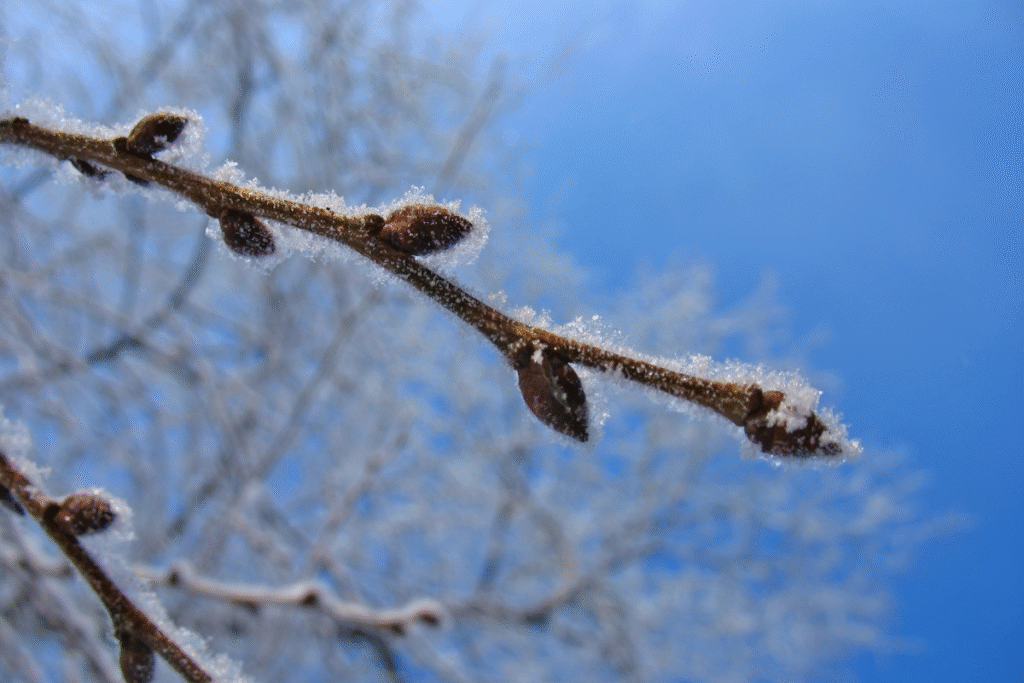
Bud development has thus been suggested as an additional cue that birds could use to predict the period of the future peak in caterpillar abundance, and thus adjust the timing of chick rearing.

Plants produce molecules involved in plant communication. Among these molecules are Volatile Organic Compounds (VOCs). Birds could use their sense of smell to assess the development of vegetation. The researcher supports the hypothesis that VOCs could play a role, based on previous studies.

When we know that plants also adapt to global changes, indirectly, sedentary bird populations could too.
Nevertheless, we can put things into perspective a little.
First, a small nuance also pointed out by the CNB: “Nesting strictly means the construction of the nest. However, most of the time, this term is used to refer to the period from the taking of a territory to the fledging of the young, including pair formation, egg-laying, incubation, and care for the juveniles. This is referred to as the nesting season.” It is therefore not immediately that the eggs will be laid!
As the expert Julien Perrot, founder of the magazine La Salamandre, explains so well: it may be counter-intuitive to listen to birdsong in January. Yet, it is the right time to practice recognizing individual bird songs. If we wait until May, we will have, as he describes it: “the symphonic concert of dozens of soloists.” It is very beautiful but difficult for practice! That is why in January, we first hear the sedentary birds and then, gradually, we will hear the migratory birds that are also beginning their nesting period (practice with Julien Perrot, link below).
Nevertheless, we can consider that February marks the official start of the mating season. It is no coincidence that the Natagora census of the most common birds takes place then.
Conversely, you might think that you don’t hear much! But remember that dawn and dusk can be the ideal times for your listening. And perhaps we are also witnessing mutations within species (refer to the recent video by Sciences Bestiales on Darwin—link below).
In conclusion
Although it is essential to consider the entire nesting period, which is not limited to the hatching of the eggs, populations of certain bird species can gradually adapt to a changing environment.
We may be witnessing profound transformations within species, natural phenomena. Yet, these changes are now occurring in a context that is not—a context marked by human-induced disturbances.
Nevertheless, let us take the time to listen to this subtle melody, this symphonic overture that marks the beginning of a complex life cycle.
Sources and cool videos to watch:
Sciences Bestiales: Charles Darwin: his life and his theory of evolution. https://youtu.be/bxNBAkRp2FU?si=OwXc9IA0YuAwRNwL
La Minute Nature, Revue La Salamandre: episode: BIRD SONGS, LESSON 1. Link: https://youtu.be/Lo0WKT1puoI?si=C330fRXVFl22YmyX
Schlicht, L. and Kempenaers, B. (2020). The effects of season, sex, age and weather on population‐level variation in the timing of activity in Eurasian Blue Tits Cyanistes caeruleus. , 162. https://doi.org/10.1111/IBI.12818.
Sam, K., Kovarova, E., Freiberga, I., Uthe, H., Weinhold, A., Jorge, L. R. & Sreekar, R. (2021). Great tits (Parus major) flexibly learn that herbivore‐induced plant volatiles indicate prey location: An experimental evidence with two tree species. Ecology and Evolution, 11. https://doi.org/10.1002/ECE3.7869
Delaitre, S. (2023). Environmental and social cues used by tits for reproductive timing and investment.
Michaël Leyman, Olivier Dugaillez, Damien Hubaut and Stéphane Claerebout. Nature-Guide® Training – Introduction to Ornithology. 1st edition: 2021. Cercles des Naturalistes de Belgique asbl.
Feel free to add to, interact with, or share interesting articles.