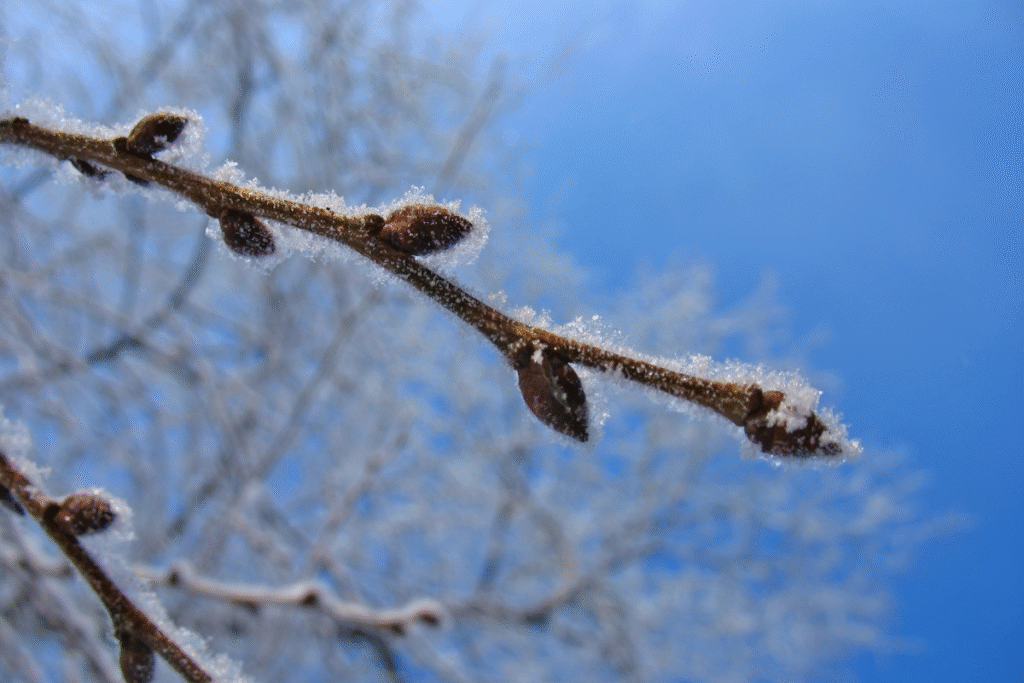
Not to be confused with mosses, which belong to bryophytes, a primitive phylum that appeared earlier on Earth.
No, we are referring to ‘plantes grasses’, succulent plants, or sometimes we use the botanical genus Sedum to describe them.
What fascinates us: their survival strategy
Succulent plants did not develop their form merely for aesthetic reasons. Their morphology is the result of trial and error, adapting to conditions relatively extreme. Where others perished, they survived. They adapted.
They are morphologically characterized by their tissues, which form the stems, leaves, and sometimes their roots, and are saturated with water*. Although the term ‘plante grasse’ suggests fat, these are not adipose tissues. Instead, it is the result of cellular formations and a physiological strategy that collectively enable the plant to retain water at all costs and utilize this resource with parsimony**.
We will find them in unusual environments, often experiencing water deficit and poor nutrient content (xeric environment).
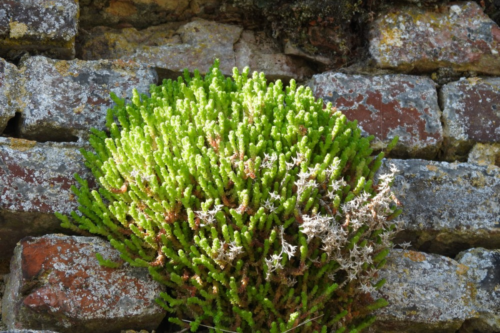
We mention this because it is our preferred candidate when working on disturbed environments with shallow soil layers, poor in nutrients, and mineral in appearance (saxicolous).
* Turgid, as it is called.
** Crassulacean Acid Metabolism (CAM), as it is called.
The harsh law of resource allocation
Its approach is to invest its energy and resources into this survival strategy. Consequently, it cannot always grow extravagantly or rapidly in size while remaining succulent.
Its choice is to retain water, thrive where others cannot, and maintain discretion. Do not be fooled by its appearance; its root system can be impressive.
Of course, some horticultural varieties/cultivars may deviate from this ecological principle. Therefore, question their “naturalness”. For our part, we will strive to prioritize indigenous species (which is not always straightforward in the trade).
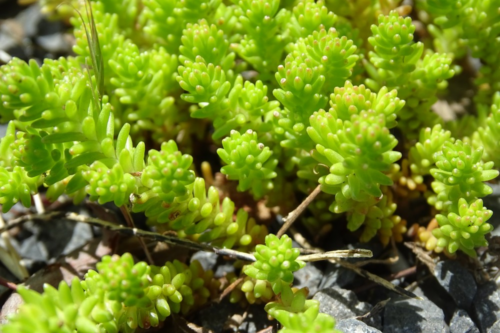
The enchantment
Yes, the enchantment is present when, one day, after a prolonged vegetative state, it offers us the impressive and fascinating spectacle of flowering.
Sometimes in spring/summer, sometimes in autumn/winter.
The challenge is that we never quite know when: they need to be ready and mature. While some may have annual flowering, for others it can take several months or even years. We then feel rewarded!