








An agroecological approach already well established
Guillaume is the agronomist and farmer in charge of this project. He manages all his land according to agroecology principles:
- Soils covered all year round, or at most four weeks without cover.
- Reintroduction of animals: a flock of sheep is brought in each year to make use of the cover crops.
- Maximising the use of organic inputs only, to feed the soils naturally.
- Planting hedgerows and trees to recreate the landscape and natural habitats.
His goal: restore soil health, increase biodiversity, and reduce erosion.
Local, resilient crops with purpose
The farmland is used as follows:
- Malting barley, stored within a local cooperative and intended for the malt house, to eventually be partly used for brewing the village beer.
- Canning peas, sold to a local cannery.
- Flax for textile fibre production.
- Rapeseed used for producing edible oil.
- Chicory for producing high-quality dietary fibres, notably as a sugar replacement,
- Bread wheat for Walloon bakers,
- Spelt for Walloon bakers
- Grain maize, less profitable but essential for improving soil organic matter levels. With this in mind, a target has been set: increase organic matter by 1% over 10 years. The major benefit? Increased water-holding capacity in the soil—more than 20 L of water retained per m² of soil.
These figures are measurable and validated by several agronomic methods. Crop rotation (including grain maize) is one of the key levers, Guillaume explains.
A local farmer turns an erosion problem into an opportunity for the area
For the past few years, this landscape has started to slide. Literally. The municipality of Hannut is facing 16 sensitive areas prone to mudflows and runoff flows.
The day the mud entered homes: one day during a period of intense rainfall, water began to rush down, laden with sediments that formed thick mud. In moments, the basements and ground floors of homes downstream were flooded. Around forty residents experienced what is known as a flash flood or flash flooding. These are sudden floods caused by intense, short-lived rainfall—but for them, it was neither a concept nor an expert term: it was their daily life swept away.
The municipality initially planned to build a dyke made of bales and an earth embankment in an upstream area. This area includes a plot managed by Guillaume.
But in discussions with a neighbouring farmer, something became clear: a more virtuous solution was needed, better integrated into the area.
“We can do better.”
This farmer, who has lived here since childhood, has seen the village change. He remembers the time when ten farms brought the village to life. And for years, he has farmed with a deep conviction: living soil protects everything that lives around it.
In discussions with the erosion unit at Natagriwal, an idea emerged:
What if, instead of a dyke, we recreated a landscape that lets water flow naturally?
The combination of permanent grassland on the one hand, like a vegetative carpet holding back rainfall, and buffer ponds on the other, helping to slow the water by tempering it, redistributing it, storing it, and allowing it to infiltrate. The municipality studied the project, and when Natagriwal confirmed its relevance, the permit was granted. Not to counterbalance nature, but to work with it again.
A landscape that becomes a solution
Today, this project is no longer just an agricultural project. We are talking about a future biodiversity sink, a space where water finds its natural rhythm again, where soils regain organic matter, and where every square metre of land retains moisture better.
It is also a social project: residents affected by these mudflows hope to find a sustainable and innovative solution here, will follow the evolution of this place with interest, and will ask their questions. And perhaps, they will reconnect with agriculture.
The project, technically speaking
This involves digging 3 buffer ponds (flood-regulating) in an agricultural setting in the municipality of Hannut. The buffer ponds, located downstream of the sub-catchment, will slow down, infiltrate, store, and evaporate runoff water in order to reduce and moderate flows towards the village downstream.
This project is carried out in partnership with Natagriwal.
Circular or elliptical in shape, the first pond will be approximately 350 m², the second 180 m², and the third 380 m².

The buffer ponds consist of a permanent water section (permanent pond) and a buffer zone. In other words: the permanent pond is located at the bottom and will in principle always be under water, and will be topped/surrounded by a buffer zone that only fills during heavy rainfall.


The excavated material is managed locally: it will be spread along the edges, in the form of a dyke, at the lowest point. The challenge is to compact the retaining dykes properly. No petro-sourced impermeable layer will be used—only the clay present on site.
Finally, rock piles will be installed near the water to provide habitat for local herpetofauna.

Good to know
To complete the system, other Nature-based regulating elements were integrated. Indeed, while the buffer ponds regulate and slow down runoff flows coming from upstream, hedges and grassed strips will also play a crucial role by promoting water infiltration and reducing diffuse erosion. Some hedges already exist and another will be planted (this part is managed by the farmer himself, who will benefit from the public grant). Although PlantC is not leading the work, it is important for us to consider the project as a whole.

And now, it is a story that can be written together
This project proves that a farm can be much more than a place of production. It can become a tool for resilience, a living laboratory, a bridge between a municipality and its history.
The companies that support this approach are not only funding ponds, hedgerows, or grasslands. They are contributing to something bigger:
- support a territory that protects itself,
- contribute to a concrete solution against erosion and mudflows,
- improve the area’s water resilience,
- support agriculture that regenerates its environment,
- strengthen local biodiversity,
- and be part of a human project led by a committed farmer.
It is time to turn our major theoretical urban planning concepts, with strong inertia, into tangible actions. This project already marks a major step forward, a first step. We commit to making it the starting point of a series of ambitious and concrete initiatives.
-
An exemplary environmental project in HannutGet inspired
The First Excavator Bucket Dig
September 22, 2026 is indeed confirmed as the start date for the works. It’s an emotional moment.
After more than 18 months on the project, seeing it come to life is still a special moment. We arrive at 8:30 AM to mark out the pond locations and start staking out the dimensions. We make a few adjustments and, finally, the first dig with the excavator!
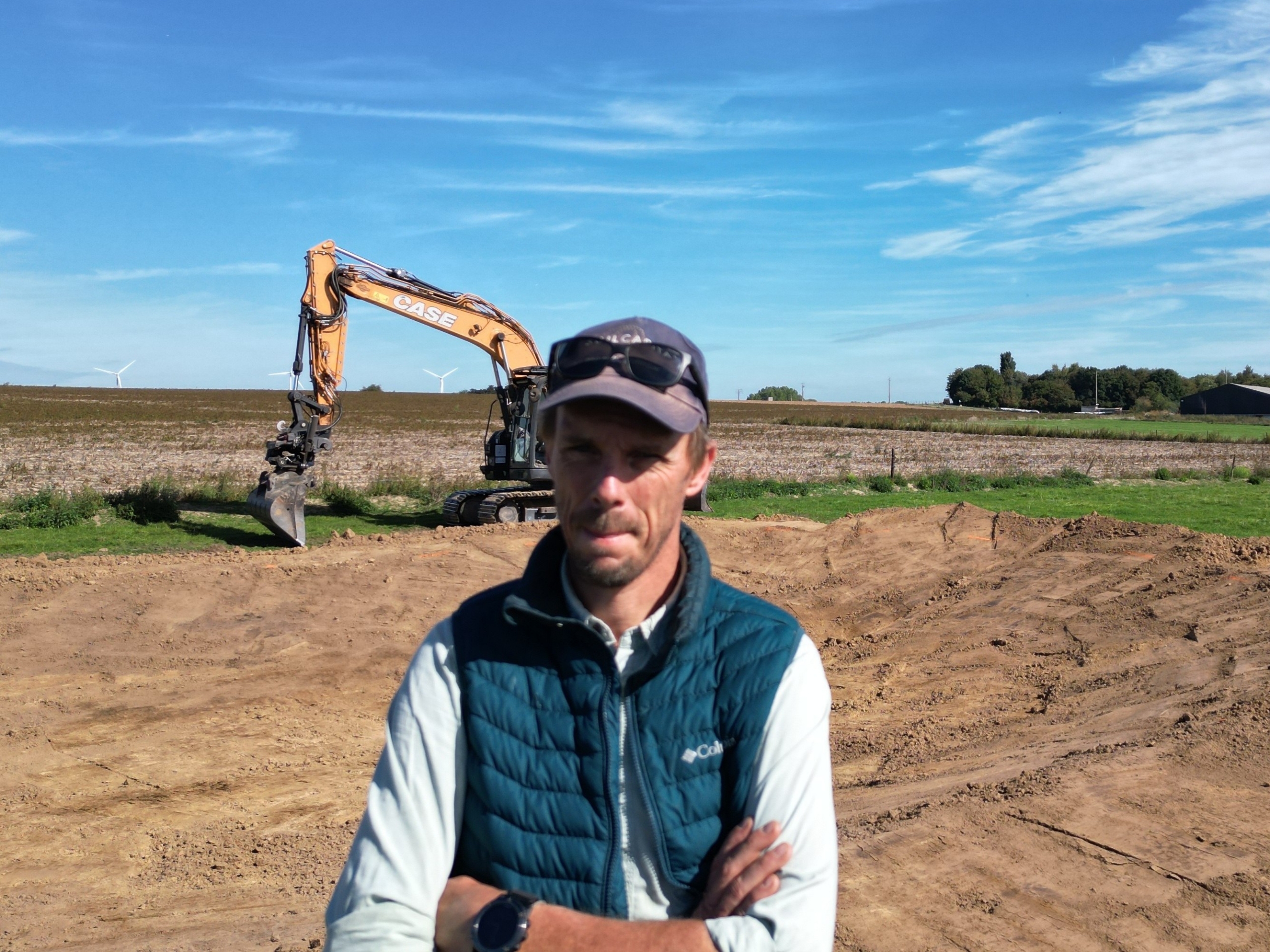
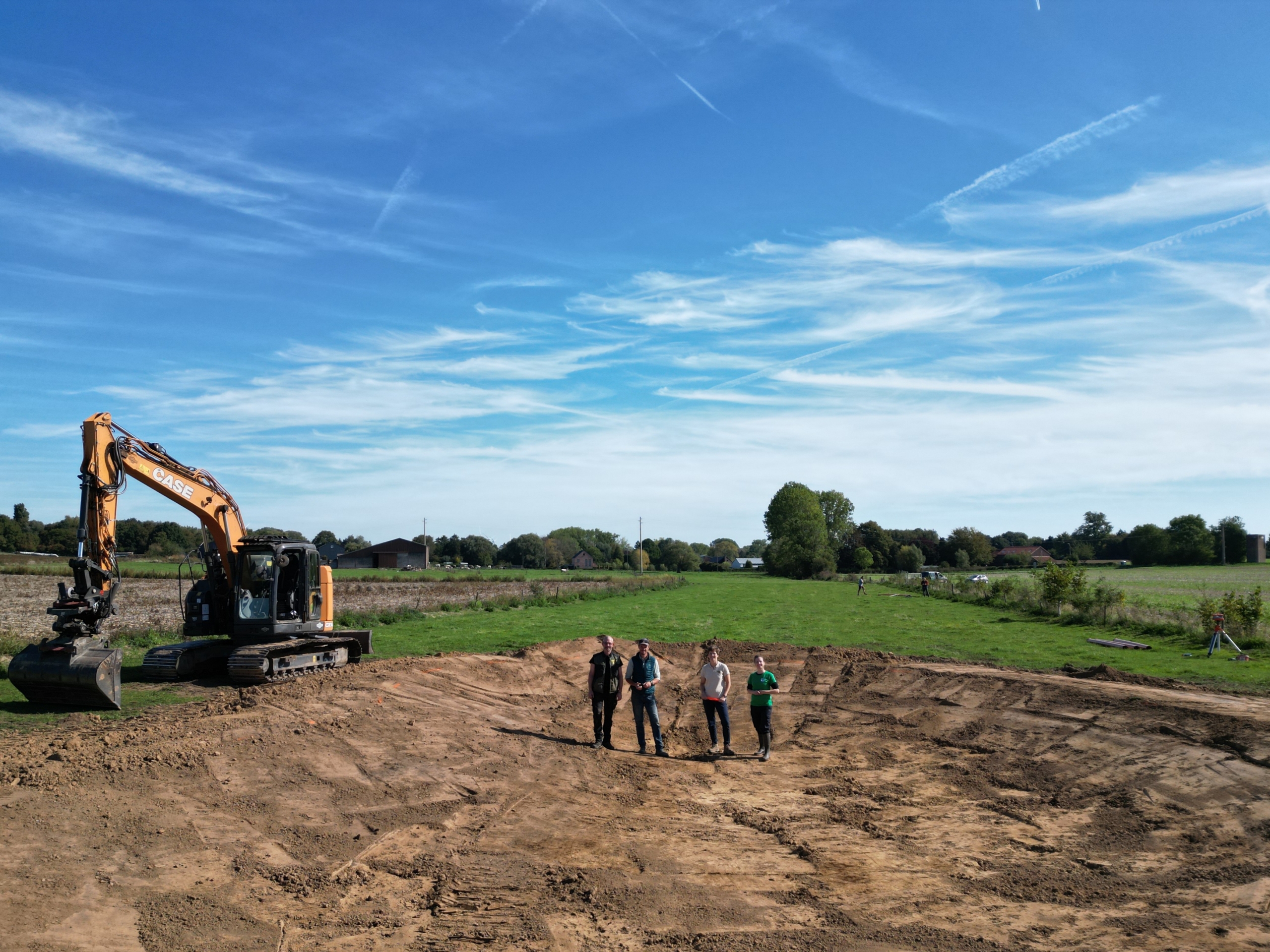
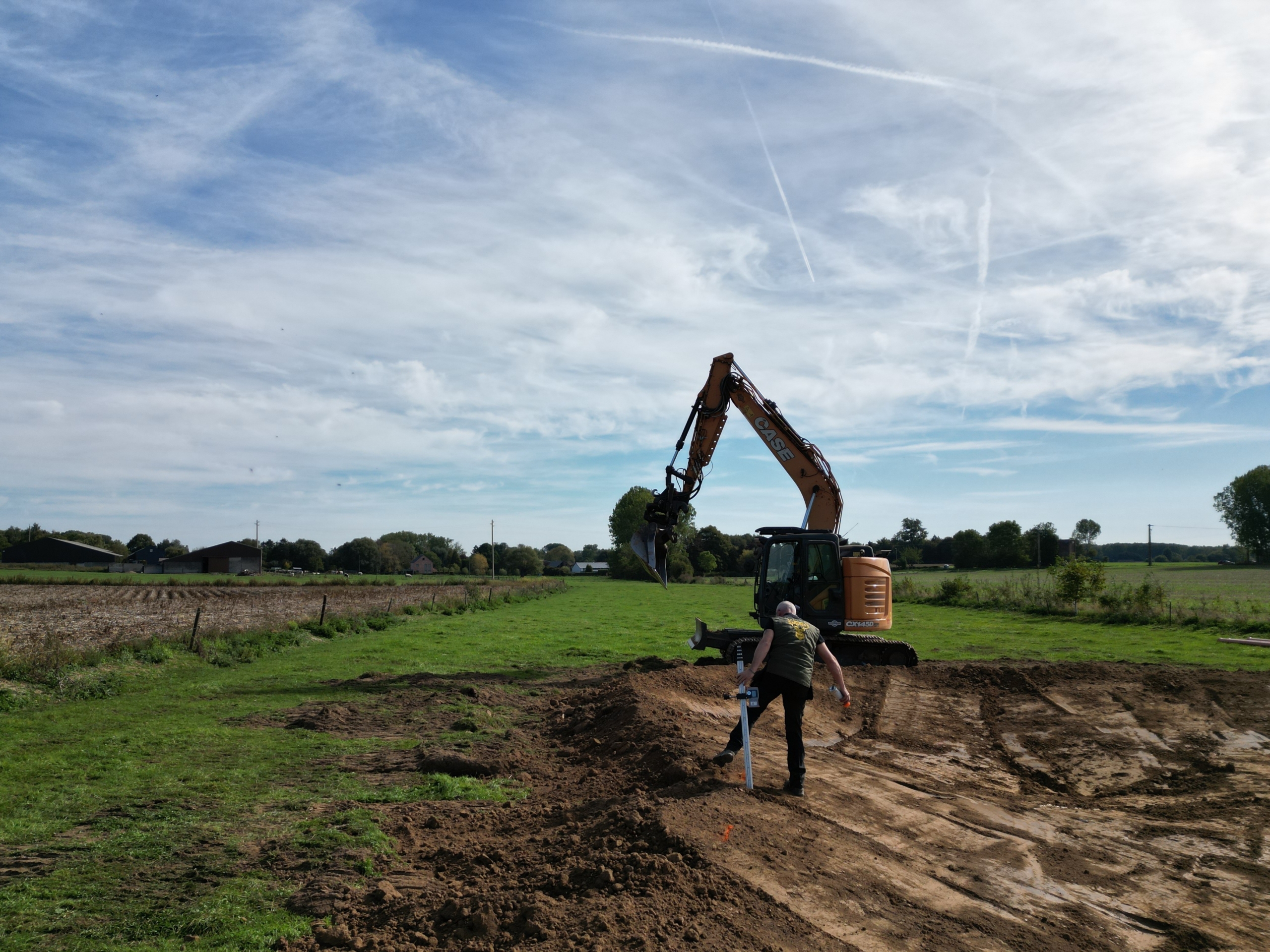
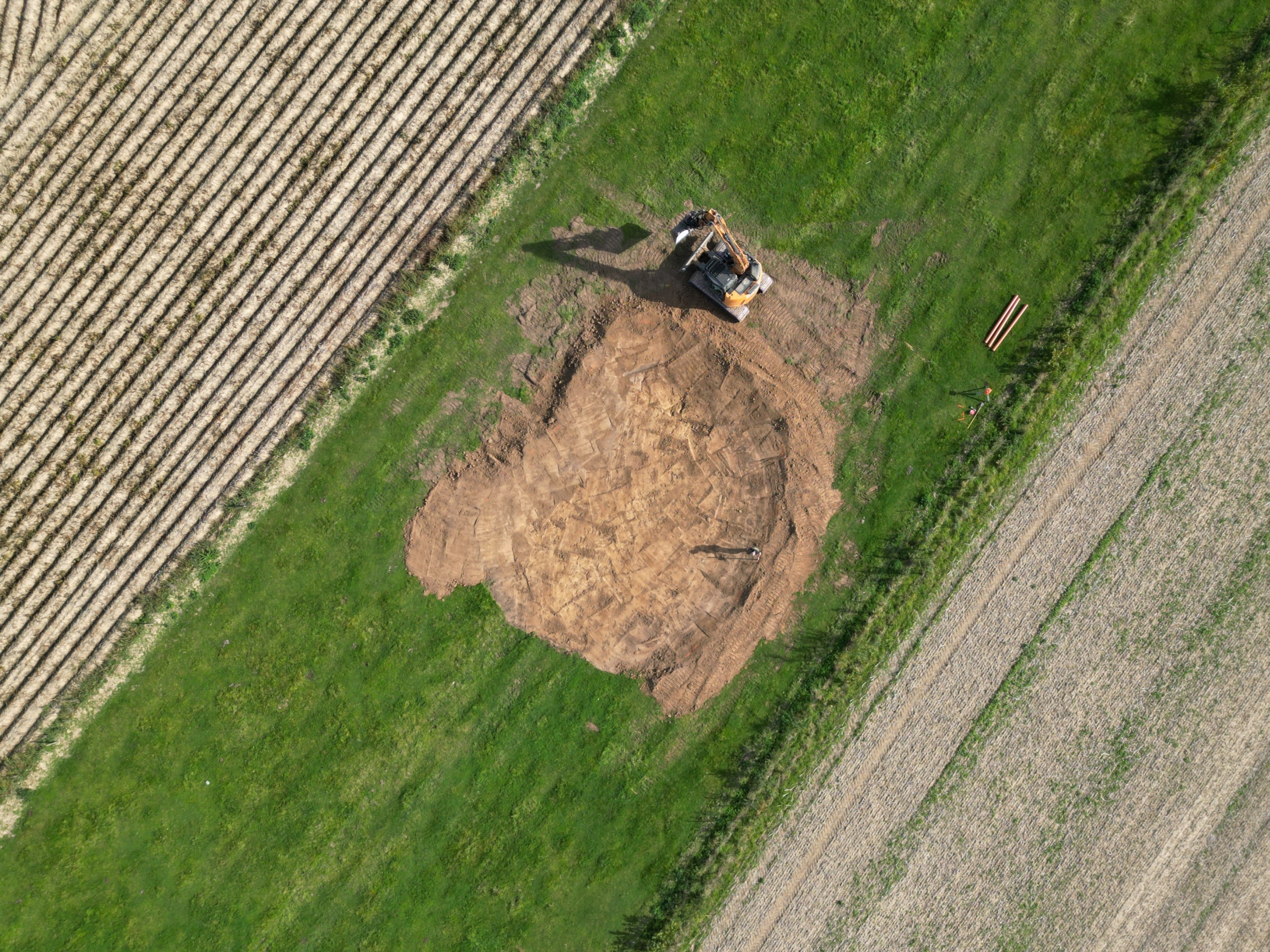
Close attention to the possible presence of drains, monitoring the progress of the work, and adapting and discussing with neighboring farmers to anticipate future fodder needs.
At the end of the works on September 24: everyone is breathing again, a little more serene if other weather events occur in the coming seasons.
It is done. And we thank you for it!
Interview with Guillaume Sneessens
Pond
-
Planting / installation period2026
-
Number of ponds3
-
Area900 m²
-
Natural / artificialNatural