

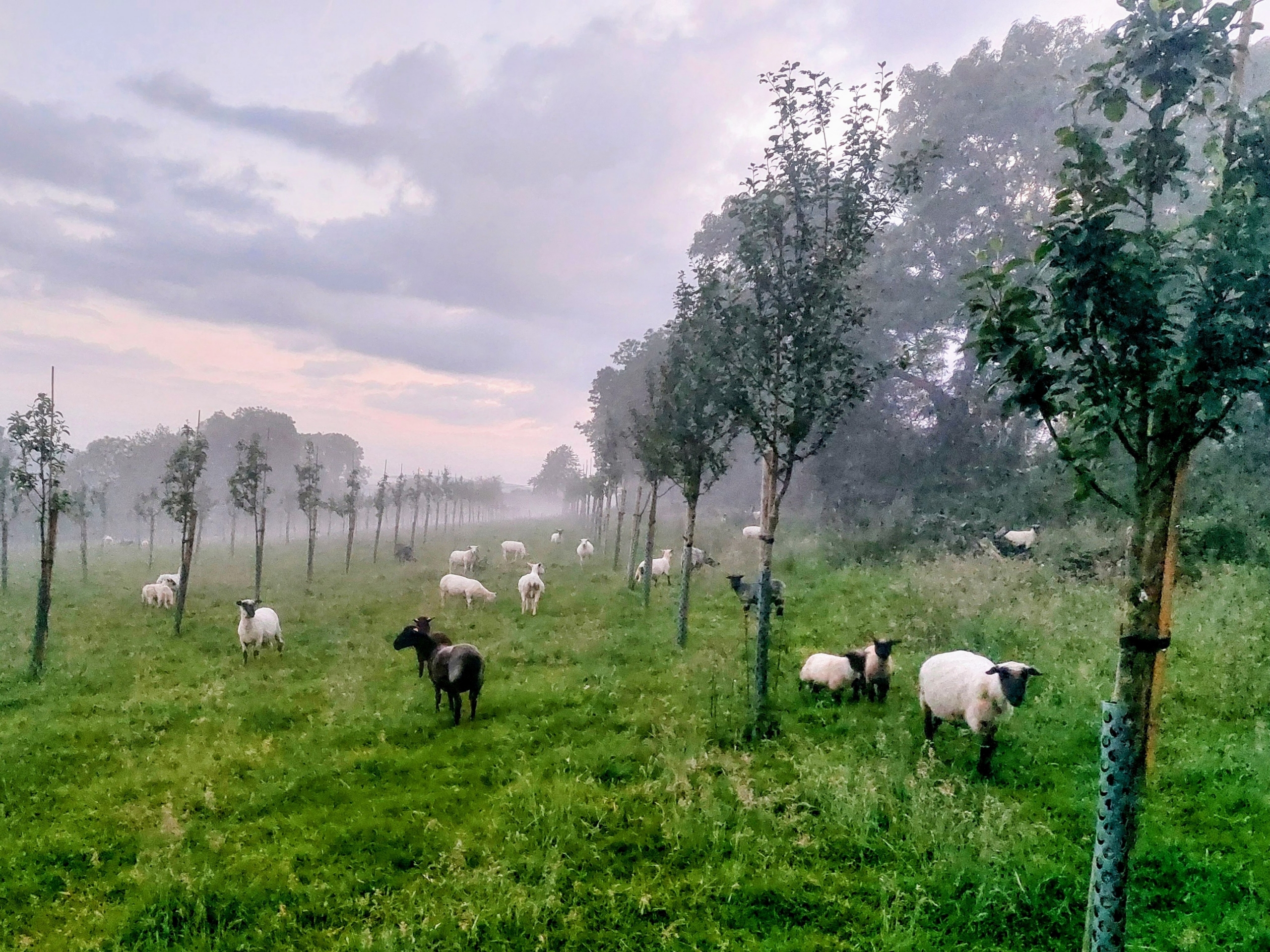
Bringing Trees Back to the Heart of the Farm
When Victor officially took over the family farm in 2019 with his partner Hélène, his vision was already clear: to put trees back at the center of the agricultural landscape.
A father of two boys and trained in agriculture, he gradually developed an agroecological operation where livestock, pastures, and orchards work in synergy.
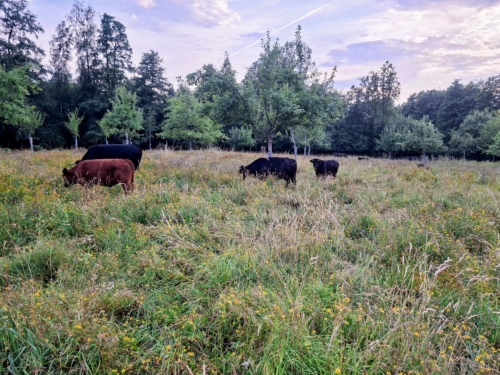
Cattle and sheep raised on the farm are fed exclusively on grass, following a logic of forage self-sufficiency and extensive farming. Over the years, he even chose to gradually reduce the size of the herd to strengthen this balance between production and respect for natural resources.
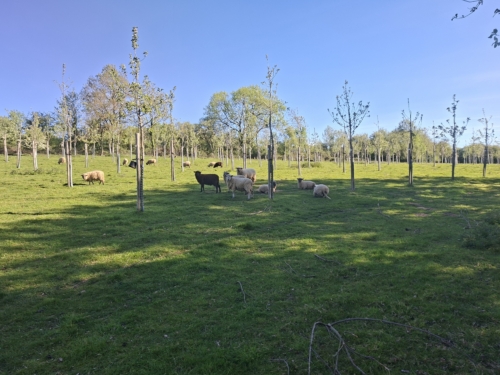
For him, agriculture, biodiversity, and economic activity are not opposed: they must advance together.
A Project That Began Long Before the Takeover
The history of the orchards actually began in 2007. At the time, he planted his first trees without a real overall plan, driven primarily by the desire to bring trees back into the fields.
A few years later, thanks in particular to the support of Cédric Guillaume, he further structured his approach and moved towards orchards with high ecological value, composed of rustic varieties adapted to the territory.
His experiences in Normandy and England, in contact with the world of cider and its processing, also fueled his reflection. They gave him the desire to develop a genuine fruit valorization sector on the farm.
Today, the farm already has more than 1,150 fruit trees. Some are planted as standard trees, others as half-standard trees on vigorous rootstocks, offering a good compromise between robustness, drought resistance, and faster fruiting.
All orchards are managed organically and benefit from the Vergers Vivants label, a recognition that highlights their contribution to biodiversity.
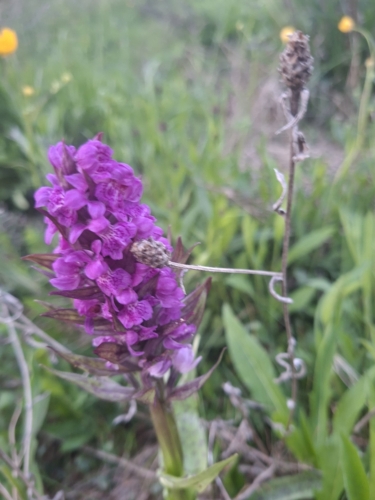
Producing Fruit… and Tomorrow, Vinegar
The orchards were designed to fulfill several functions: producing fruit, enhancing local biodiversity, providing shade for animals, and recreating a more resilient agricultural landscape.
But the project goes further.
Passionate about fruit processing, he wishes to develop in an old stable a craft vinegar factory to directly process the harvests produced on the farm.
Cider apples and pears will notably allow for the production of craft vinegars and higher value-added products. Part of the harvest will also continue to be valorized as table fruit.
This approach aims to control the entire value chain, from the tree to the finished product.
A New Step Forward Thanks to PlantC
The project submitted for PlantC support includes the planting of 350 additional trees.
As with previous plantings, the varieties were selected for their hardiness, their suitability for local conditions, and their ability to produce sustainably without treatments.
These new trees will strengthen the farm’s ecological network while increasing its future production potential.
In a context where public aid for fruit tree planting sometimes becomes complex or uncertain, the support provided by PlantC represents a concrete lever for continuing this long-term dynamic.
Planting for the Next Generation
Beyond agricultural activity, every tree planted constitutes an investment in the landscape, climate, and biodiversity.
Orchards store carbon, shelter a multitude of species, improve the farm’s resilience to climate hazards, and contribute to the beauty of the territory.
For Victor, the motivation is also family-oriented:
“Planting today means building something that will still be here tomorrow. I hope my children will see these trees grow and continue to keep this farm alive with respect for nature.”
-
Orchard Project: Craft Vinegar Production and Biodiversity Preservation in HamoirParticipate in this project
Orchard
-
Planting / installation period2026-27
-
Number of trees350
-
Area9 000 m²
List of selected varieties
| Apple trees | 200 |
|---|---|
| Pear trees | 100 |
| Plum trees | 50 |
Wildlife shelters
-
Number of shelters41
Targeted species
| Tits |
|---|
| Wagtails, wrens, redstarts |
| Barn owls |