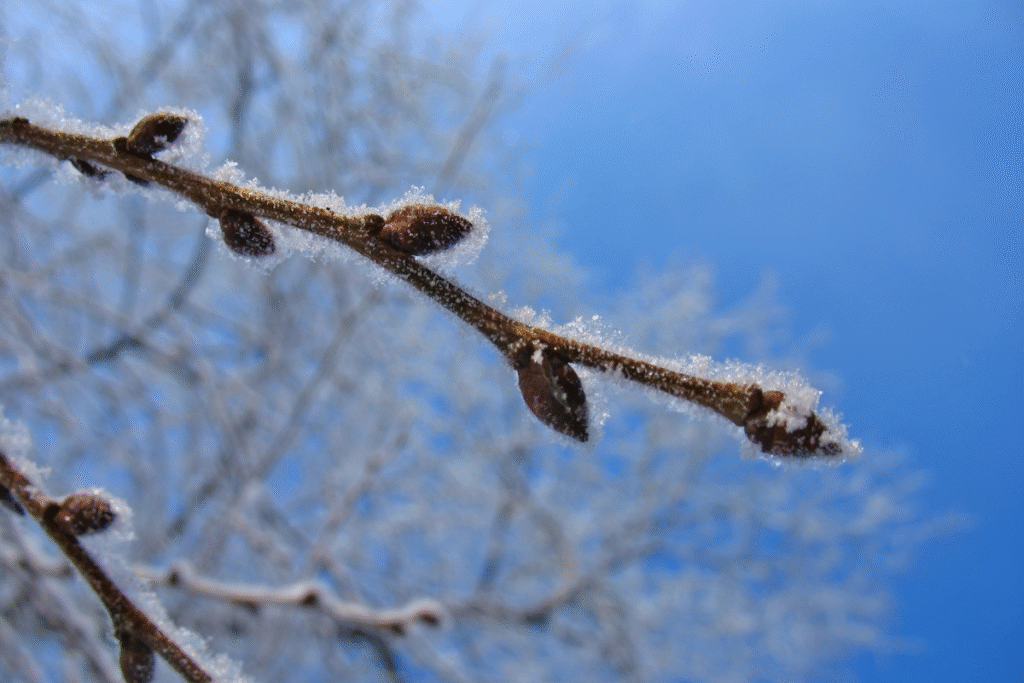
As is often the case, showers are abundant during this planting season. And when it’s not rain, frost sets in.
The result? Planting projects were delayed, or even completely postponed until the following year, in the hope of a milder autumn. Nevertheless, we aim to provide you with some solutions for planting under such conditions.

Extremely wet winters and very dry springs
According to these graphs, the autumn average for 2023 is significantly higher than the average precipitation between 1991 and 2020, reaching 283.7mm by the end of the season.

A more in-depth analysis reveals that the average insolation periods for autumn 2023 are higher than the average between 1991 and 2020. Concurrently, the average number of precipitation days is slightly higher in 2023.
Higher average precipitation translates to more intense and sporadic precipitation periods in 2023. Inevitably, this is not good at all for plantations. Indeed, Wallonia features a variety of soils with very different profiles. Some soils are well-draining, while others are not at all.
In the Ardennes, a region with particularly clayey soils and generally high precipitation, young plants will not fare the same way as in Gembloux, where the soil is silty with naturally favorable drainage.
Nevertheless, this year, precipitation was such that planting times were shifted, risking young plants being waterlogged. And when the ground was not wet, frosts were so intense that planting could not proceed as planned.

According to IPCC experts, winter precipitation is likely to increase, accompanied by a strengthening of precipitation seasonality between winter and summer. By 2100, a decrease in precipitation of up to -25% is expected, alongside a +22% increase in winter (IPCC, 2013).
So, what should be done? Should we halt all planting projects? That would be a great shame, considering that plants play a valuable role in mitigating these environmental issues.
Action / Reaction
One solution, which may seem obvious, is to be attuned to local conditions and sufficiently flexible and resilient to be able to plant when a window of opportunity arises. To achieve this, it is necessary to regularly check the weather forecast, and we advise you to reserve your plants well in advance at your nursery so that they are available when needed.
Containerized or bare root?
Another solution, albeit more expensive, is to order containerized plants, which can be planted over a longer period, thus benefiting from a more favorable climate for the successful establishment of future plants.

The right tool for every situation
A third solution concerning planting technique is to prioritize the hoe-axe over the auger when possible. The mechanical effect generated by the auger on wet soil will scatter the soil in large clumps, whereas the hoe-axe will not disrupt the soil’s surface horizon.

One day, my plant will come…
As the saying goes, patience is a virtue.
The ultimate solution could be to postpone the planting project until next year, hoping for a more favorable season.

In conclusion, what we observe is that winters are becoming increasingly mild. This encourages us to plant later and later. The adage “on Saint Catherine’s Day, all wood takes root” is becoming shaky, so to speak. This contributes to reducing the window of opportunity.
Sources
https://www.meteobelgique.be/article/releves-et-analyses/annee-2023/2532-bilan-de-l-automne-2023
IPCC, 2013: Summary for Policymakers, Climate Change 2013: The Physical Science Basis. Contribution of Working Group I to the Fifth Assessment Report of the Intergovernmental Panel on Climate Change [edited by Stocker, T.F., D. Qin, G.-K. Plattner, M. Tignor, S. K. Allen, J. Boschung, A. Nauels, Y. Xia, V. Bex and P.M. Midgley]. Cambridge University Press, Cambridge, United Kingdom and New York (New York State), United States of America.
Lenssen, N., G. Schmidt, J. Hansen, M. Menne, A. Persin, R. Ruedy, and D. Zyss, 2019: Improvements in the GISTEMP uncertainty model. J. Geophys. Res. Atmos., 124, no. 12, 6307-6326, doi:10.1029/2018JD029522.